
UX Design | Case Study
SHIFTLY STUDENT JOB APP
Problem
This project looks into the everyday struggle students face when trying to find part-time, flexible work. Juggling studies with changing schedules often makes it hard to hold onto a steady job, while places like cafés and restaurants can suddenly find themselves short-staffed when someone can’t make a shift. The result? Students lose the chance to earn money, and employers are left under pressure.
Goal
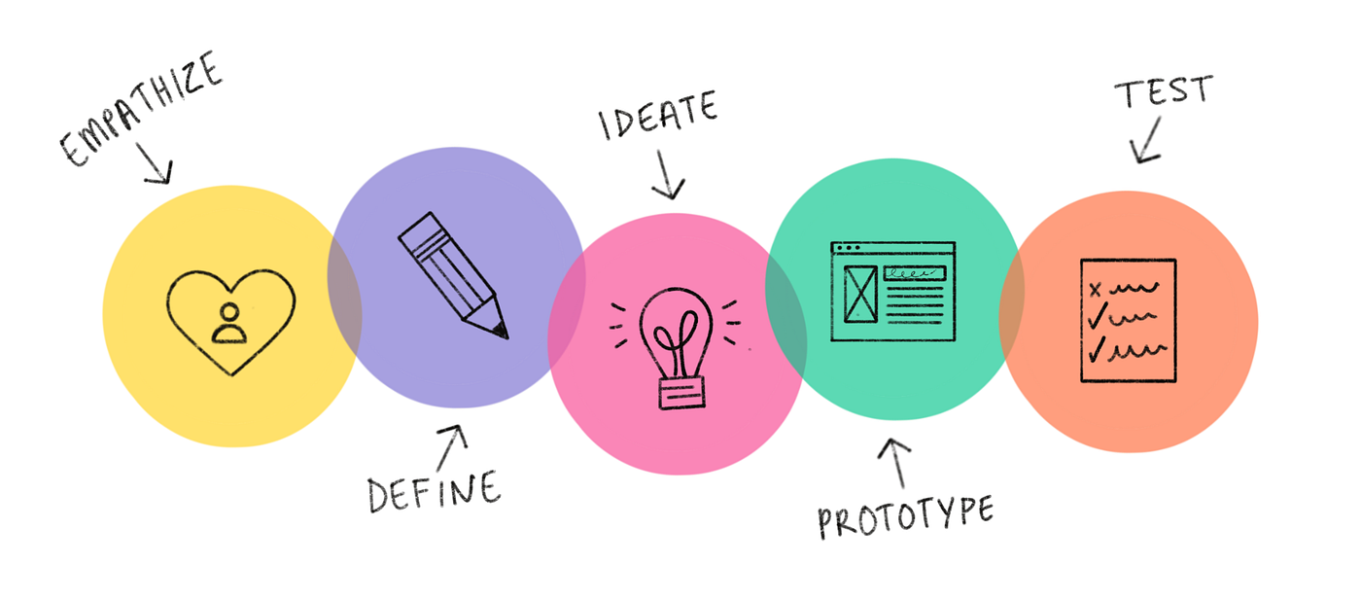
To see how design can step in and make things easier. Using the Design Thinking process, I’ll dig into the real needs of students and part-time workers, uncover the main challenges, and shape a digital solution that helps connect people with short-term opportunities more smoothly. Throughout the work, I’ll keep the focus on user-centered design testing, iterating, and making sure the final concept feels simple, inclusive, and useful for everyone involved.
Audience
Throughout the work, I’ll keep the focus on user-centered design testing, iterating, and making sure the final concept feels simple, inclusive, and useful for everyone involved.
Design Process
Research Goals

Understand the main challenges students face when finding flexible, part-time work.

Identify when and why students need short-notice jobs.
Identify when and why students need short-notice jobs.

Identify when and why students need short-notice jobs.

Identify when and why students need short-notice jobs.
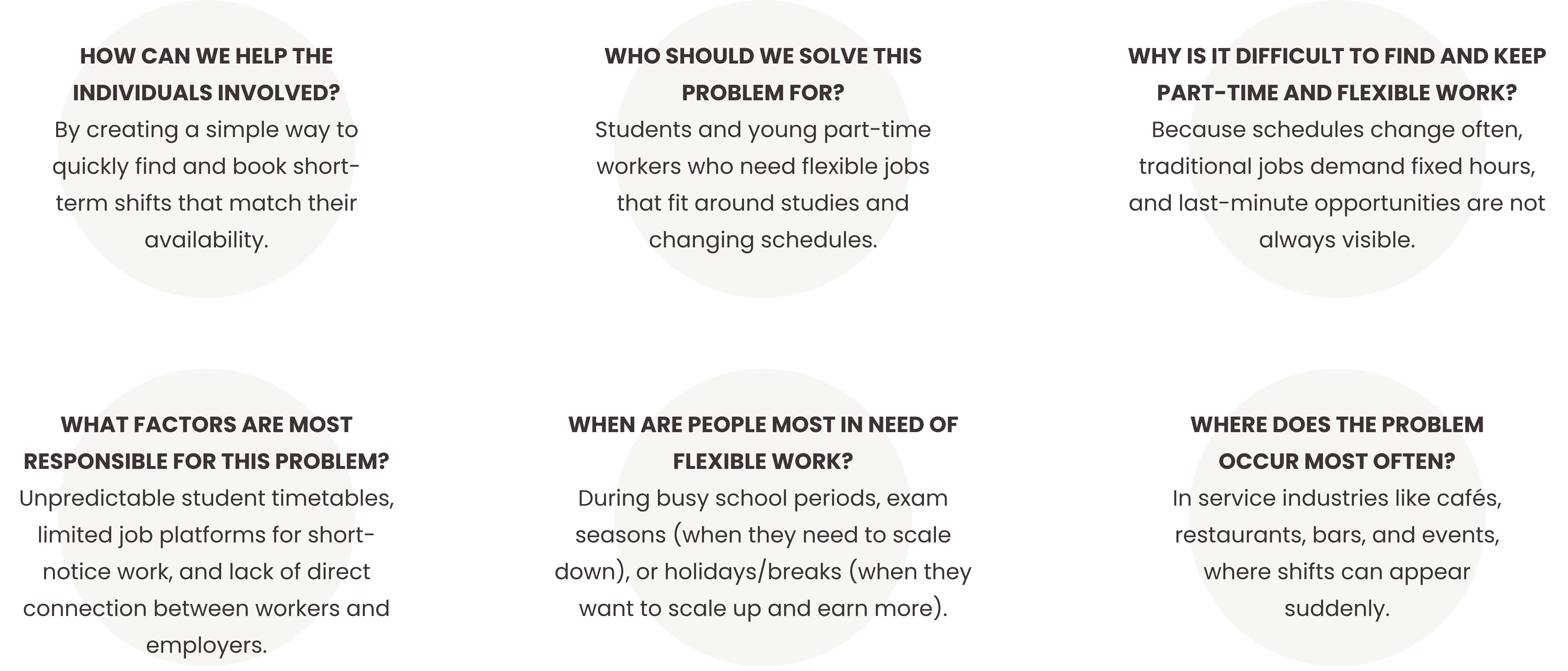
Exploring the student/worker’s problems
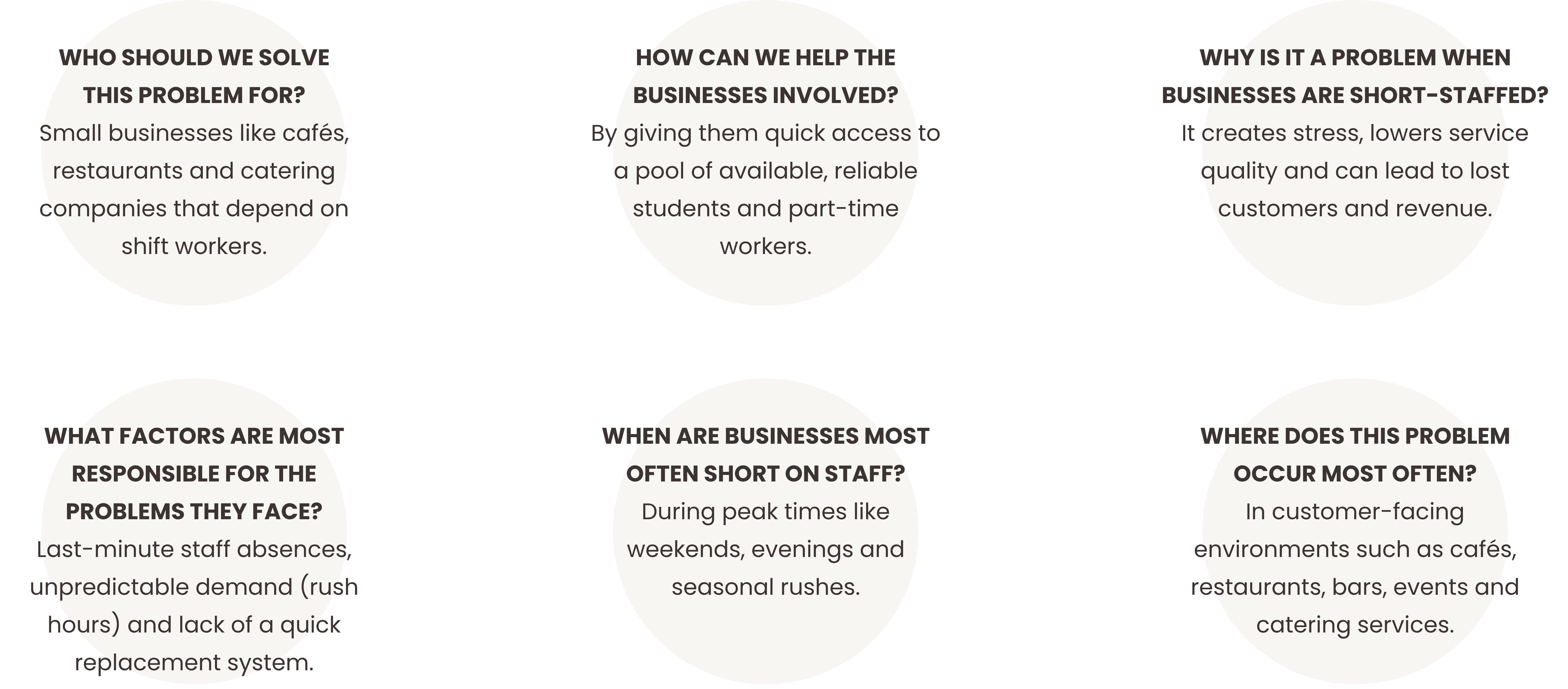
Exploring the employer’s problems
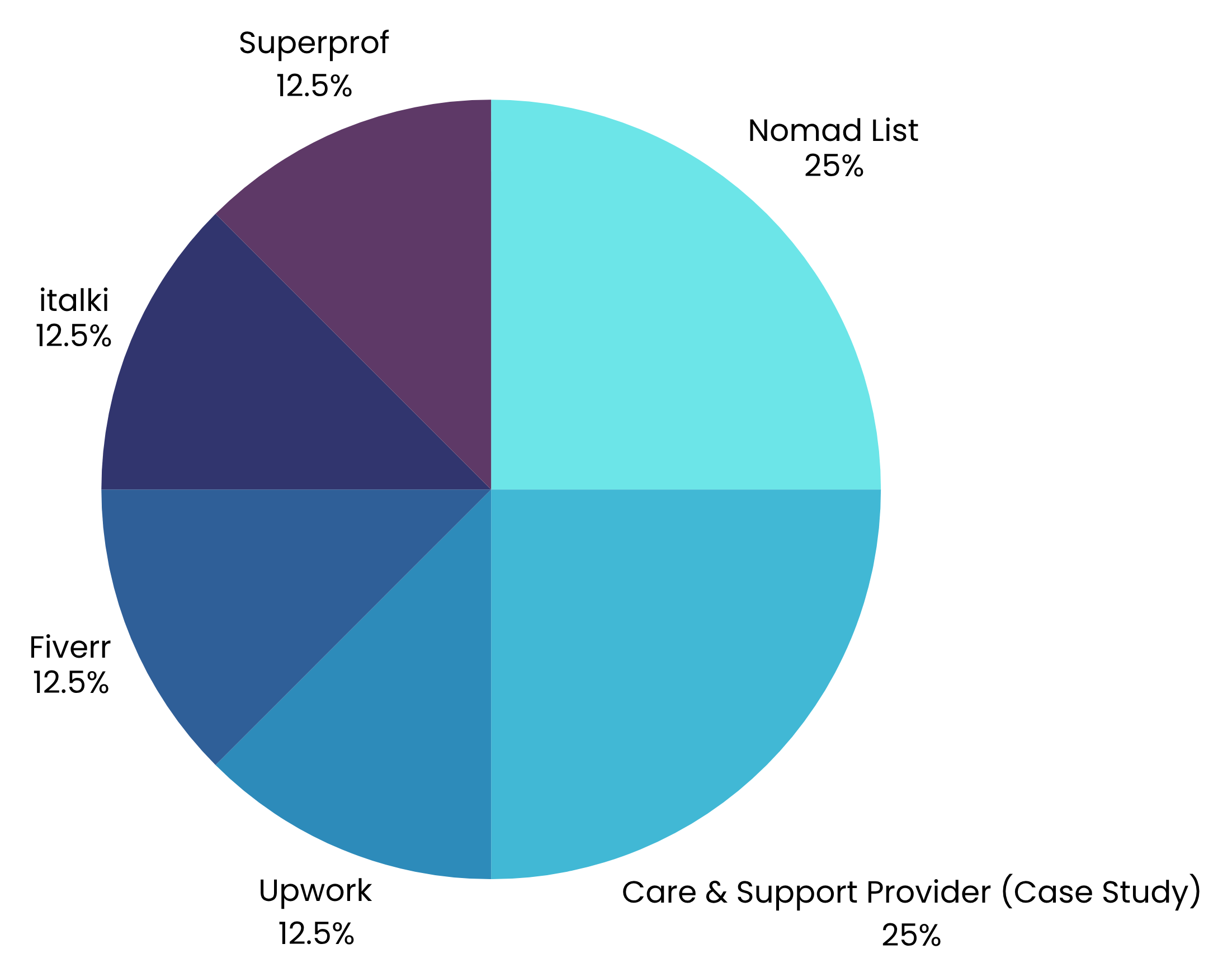
Insights from Competitor Analysis
- Most platforms target freelancers, digital services, or niche industries (design, tutoring, healthcare).
- Common strengths: verified profiles, reviews, instant booking, and global reach.
- Weakness: not designed for students needing local, flexible, short-notice jobs.
Gaps & Opportunities
- Lack of platforms focused on students balancing studies with part-time work.
- Few solutions highlight local jobs nearby (cafés, restaurants, events).
- Opportunity to build trust-based features (verified employers, safe payments) for short-term shifts.
- Potential to design an app that supports on-demand scheduling, matching availability with last-minute jobs.
Data Analysis
(Student Part-Time Work Survey)
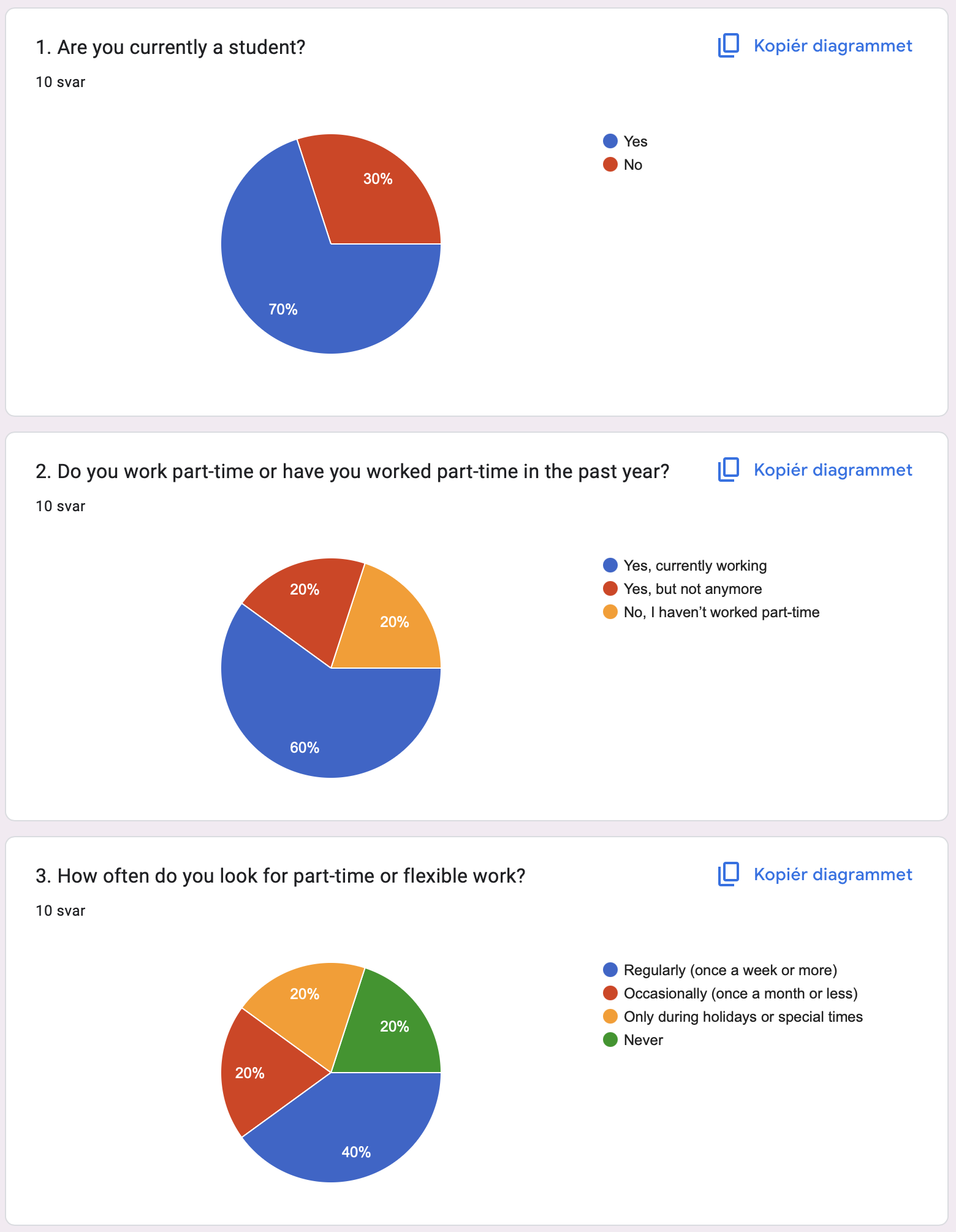
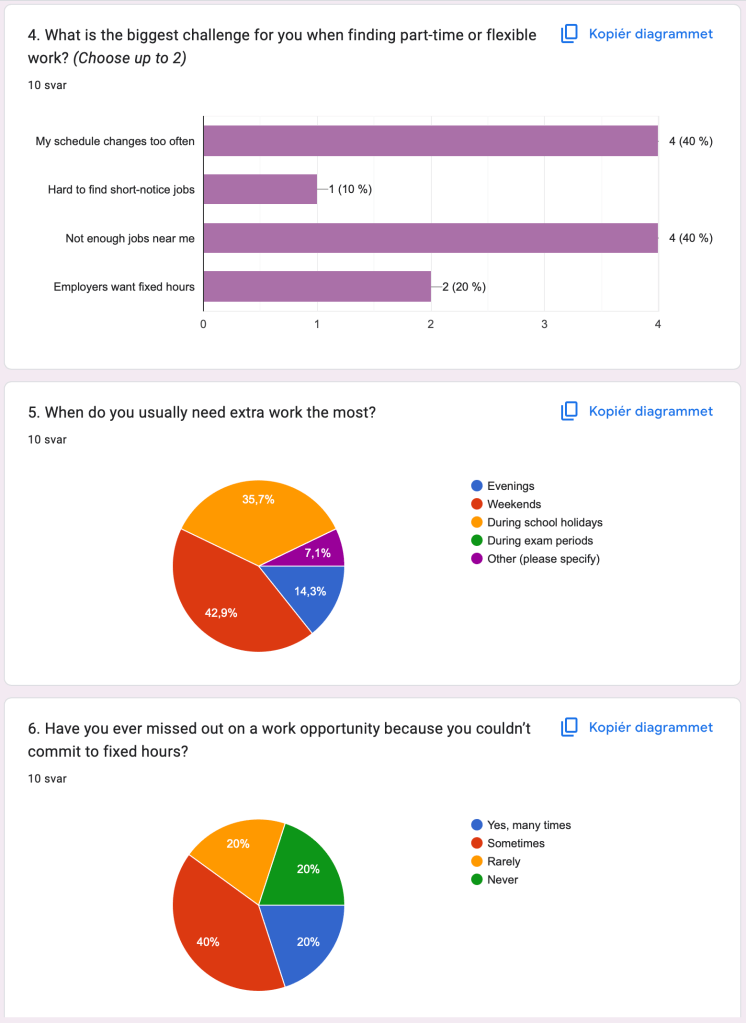
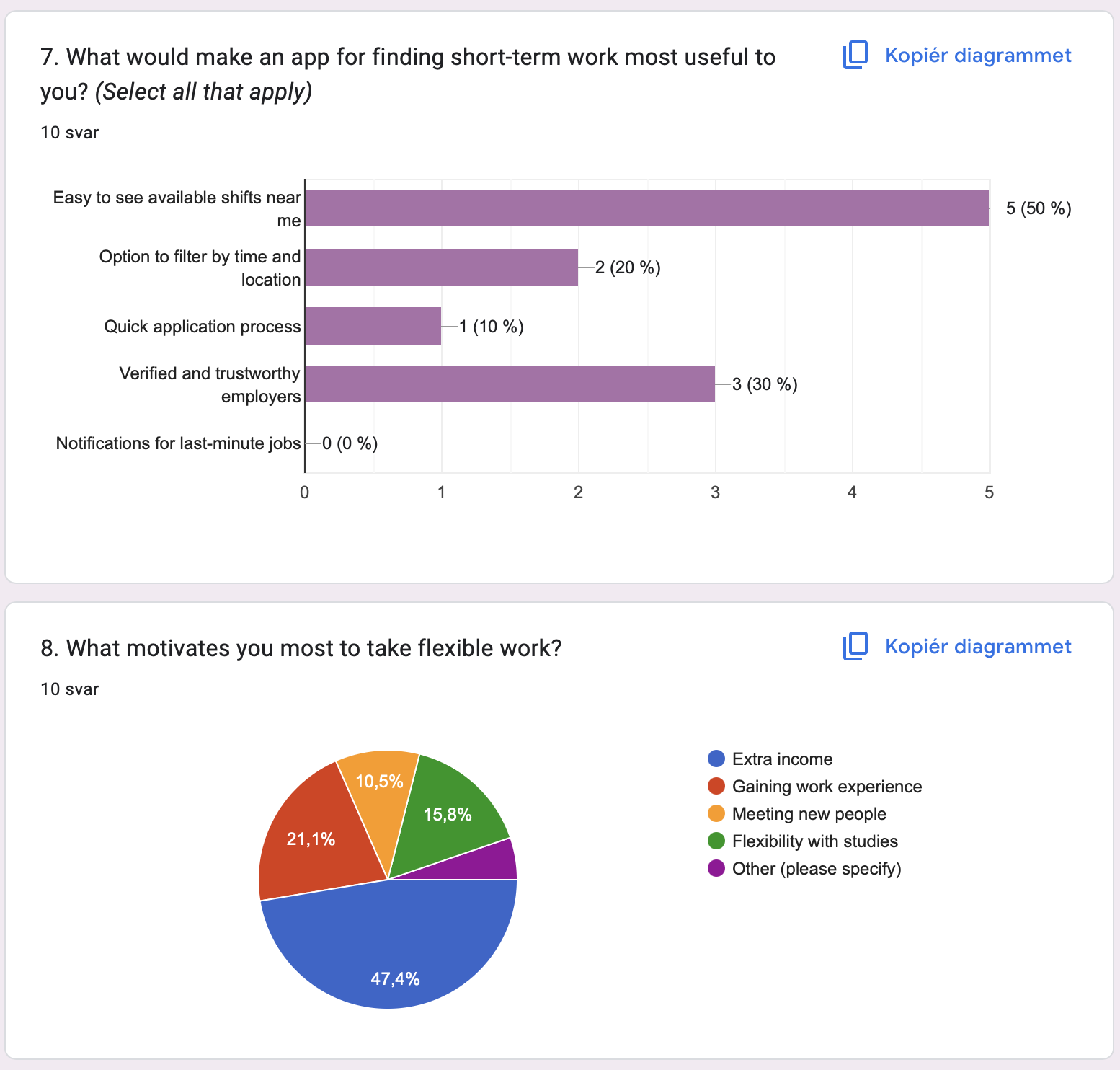
Data Analysis Overview – User Survey
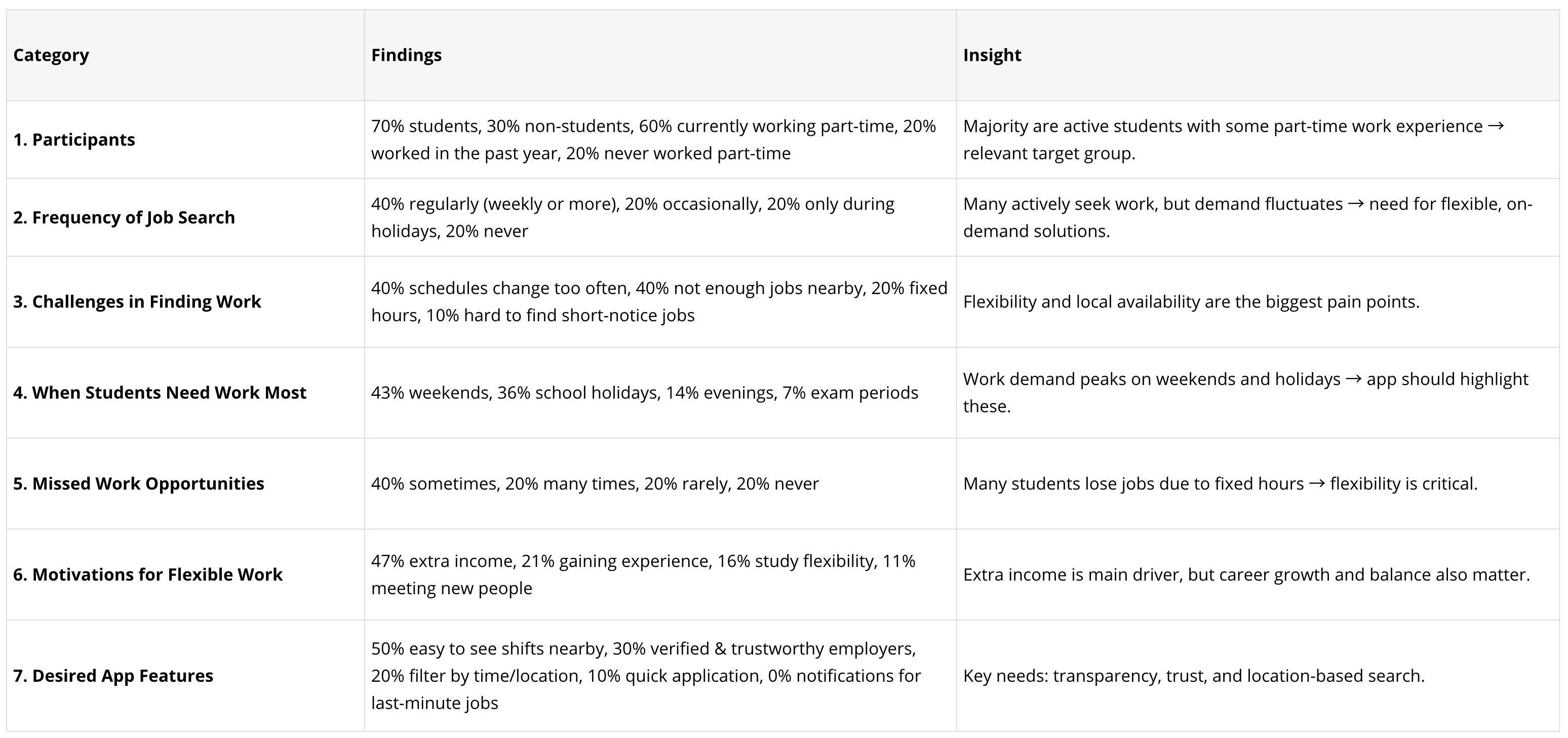
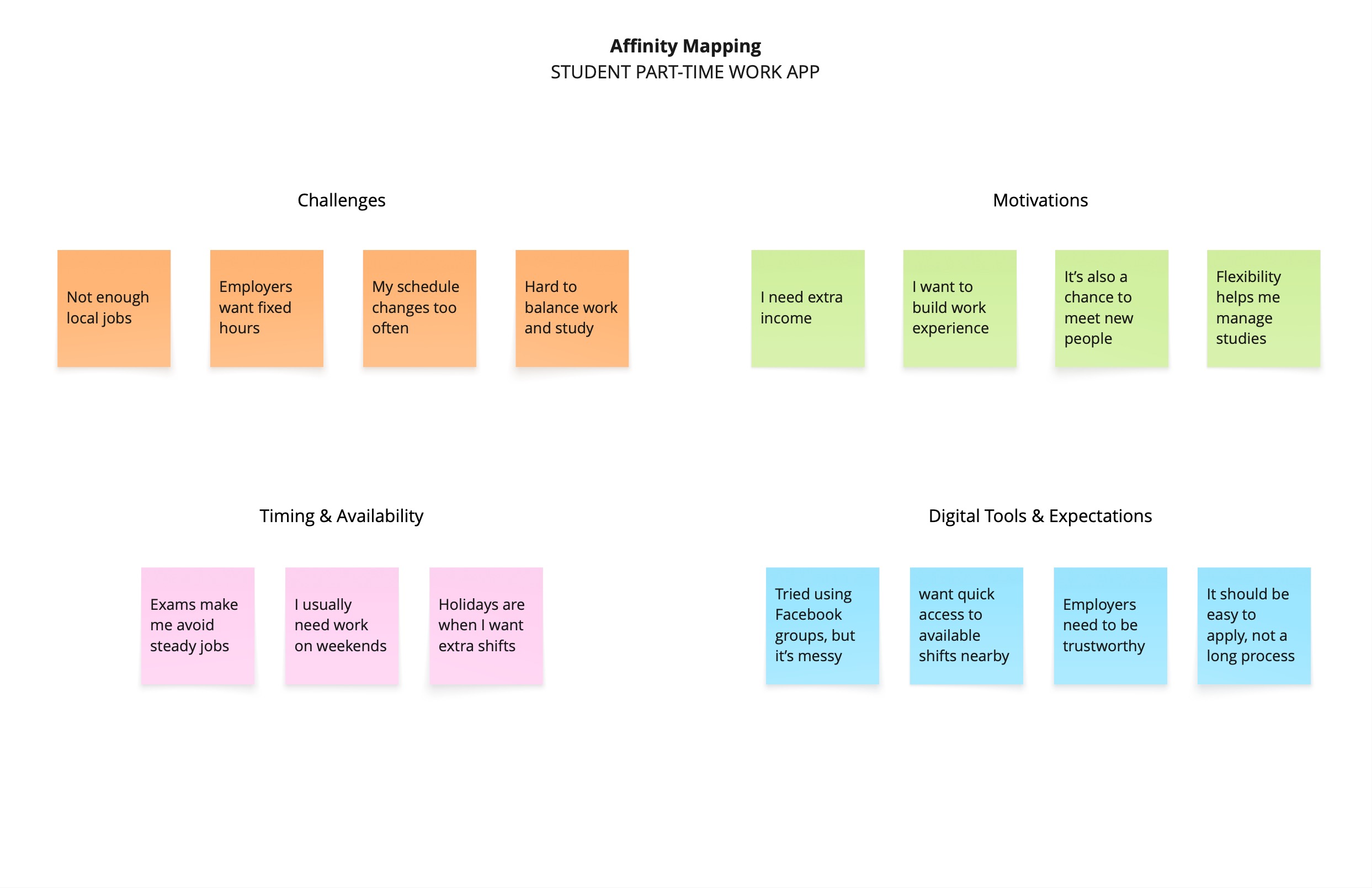


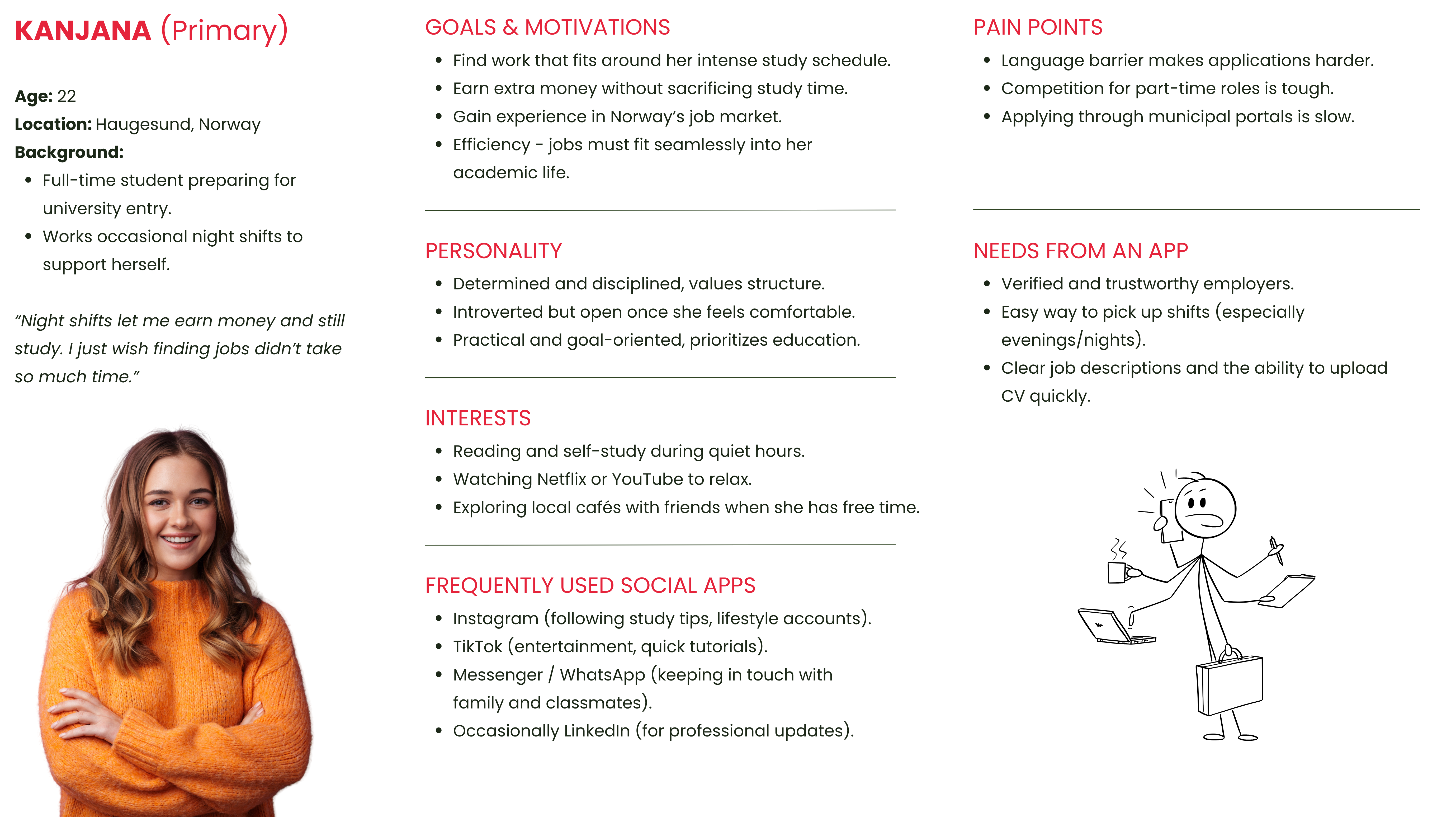
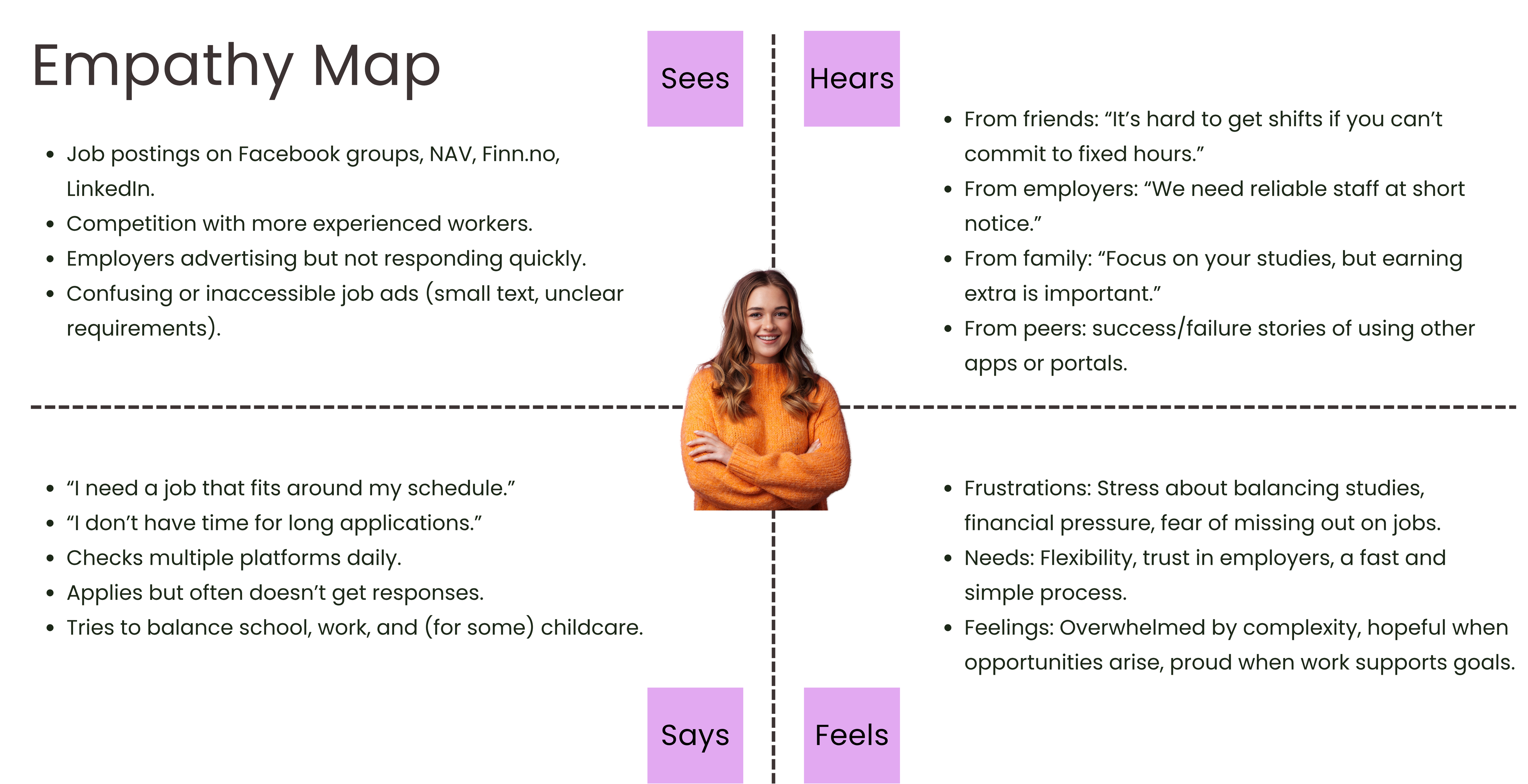
Context scenario
1.
Thursday class is canceled; she wants to grab a last-minute night shift to earn extra money.
Profile complete (CV uploaded), ID verified, location enabled.
Availability set to “Evenings/Nights, Thu–Sun.”
2.
Student-app sends a push: “2 night shifts nearby tonight.”
Kanjana opens the app; default view shows tonight 20:00–02:00 within 5 km.
3.
She filters by “Allows study during quiet hours” and “≥ 4★ employer rating.”
4.
Reviews two options; checks pay rate, distance, break policy, dress code.
5.
Opens employer profile → sees verified badge, recent positive reviews, and consistent night-shift postings.
Taps Book Shift → app auto-fills CV and profile; she confirms availability.
6.
System runs quick conflict check (no overlaps) and shows route time (18 min bus).
She confirms; gets instant confirmation, calendar syncs, and checklist appears (arrival time, contact, QR check-in).
7.
At venue, she QR check-ins, completes tasks; notes quiet period for study from 00:00–01:30.
8.
After shift, she checks out, leaves a review, and sees payment pending to wallet in 24–48h.
Shift completed, review posted, earnings scheduled, employer saved to favorites.
Context scenario
Problem Statement
Our WHO (user) are WHAT (problem) because they WHY (reason). If we can solve this problem, it would impact (user) positively by/because (customer benefit). It would also benefit our business by/because (business benefit).
Students (WHO/USER) often struggle to (WHAT/PROBLEM) find part-time work that fits their unpredictable schedules.(WHY/REASON) Traditional job platforms and fixed-hour roles don’t accommodate last-minute availability, (CUSTOMER BENEFIT) leading to missed income opportunities for (USER) students and staffing shortages for businesses like (BUSINESS BENEFIT) cafés and restaurants. Existing digital solutions focus on freelancers or niche sectors but do not address the specific needs of students seeking local, flexible, and short-notice jobs.
Vision Statement
Our vision is to design a student-focused digital platform that makes finding flexible, trustworthy, and local part-time work quick and effortless. By matching students’ availability with real-time job openings, the app will empower students to earn on their own terms while helping businesses fill urgent staffing needs—creating a win-win solution built on flexibility, trust, and simplicity.
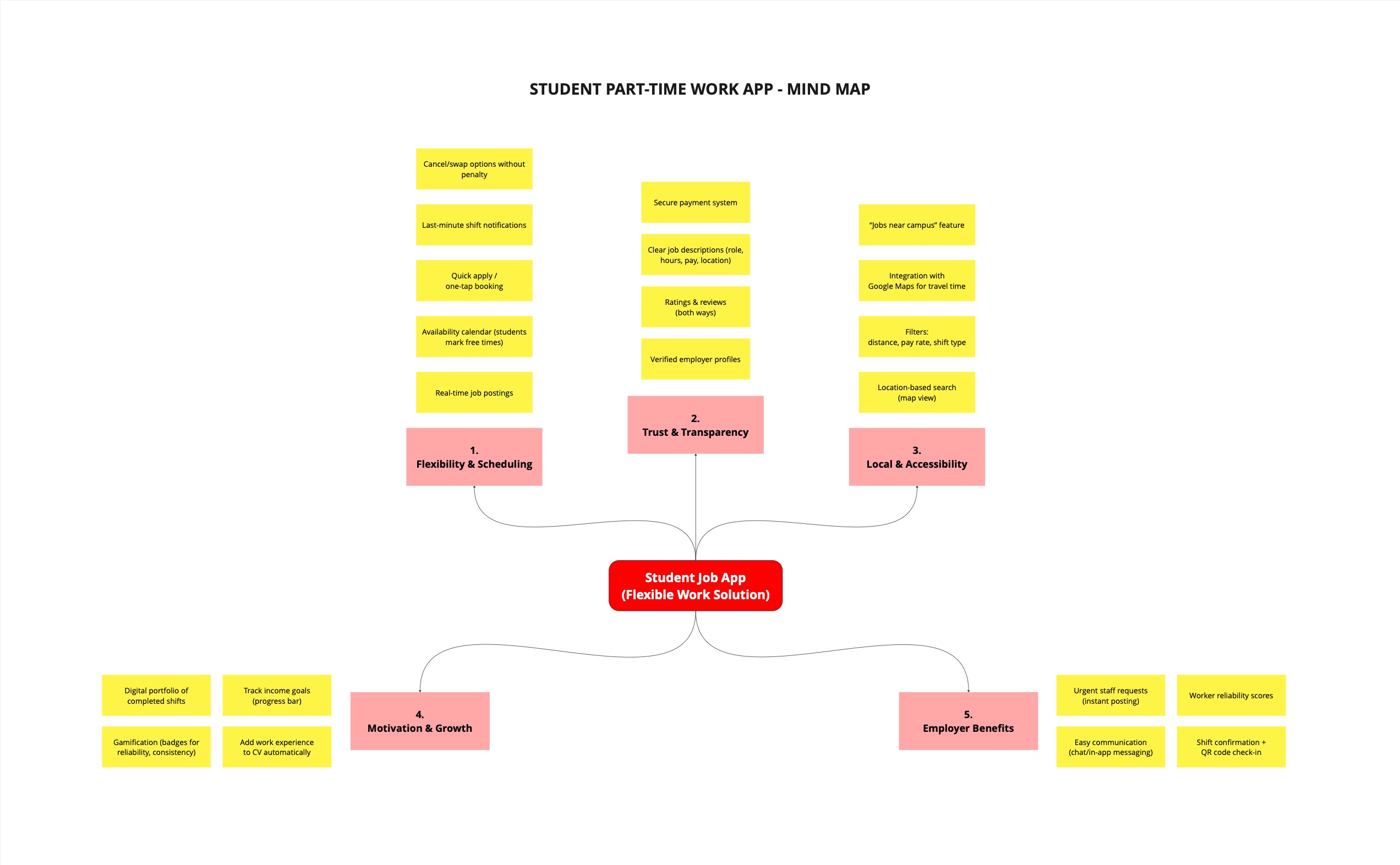
“How Might We” (HMW) Questions
Flexibility & Scheduling
- HMW help students find part-time work that adapts to their changing schedules?
- HMW allow students to pick up last-minute shifts without stress?
- HMW reduce the time and effort it takes for students to find suitable work?
Trust & Transparency
- HMW make sure students feel safe and confident that job listings are real and employers are trustworthy?
- HMW design features that give students clear job details before they apply?
Local & Accessibility
- HMW make it easier for students to find jobs close to home or campus?
- HMW show students the most relevant jobs quickly, without scrolling through endless listings?
Motivation & Growth
- HMW help students find work that not only pays but also adds experience to their CV?
- HMW design a system that motivates students to return and use the app regularly?
Employer Context (for balance)
- HMW help small businesses fill urgent staff shortages quickly?
- HMW connect employers with reliable student workers on short notice?
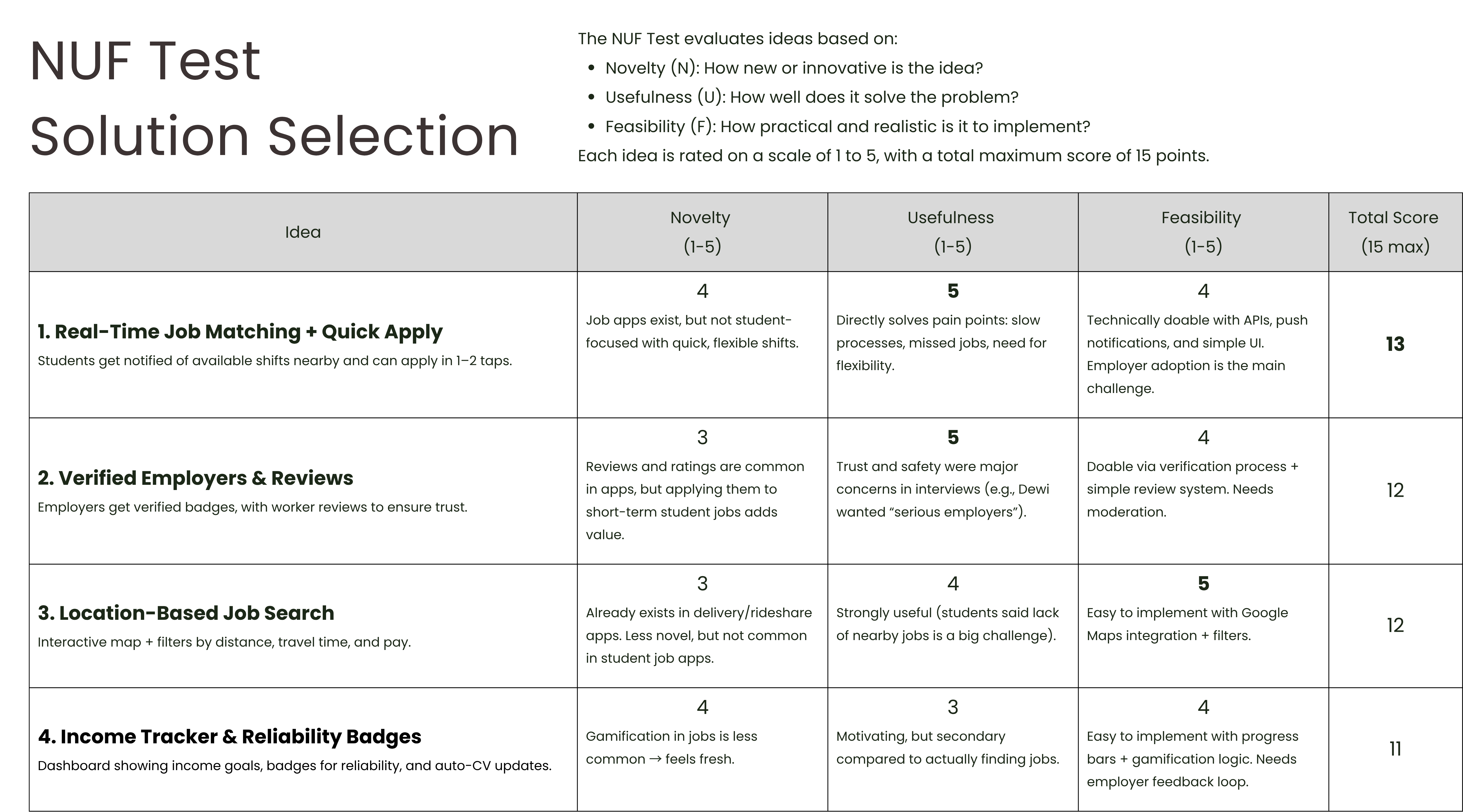
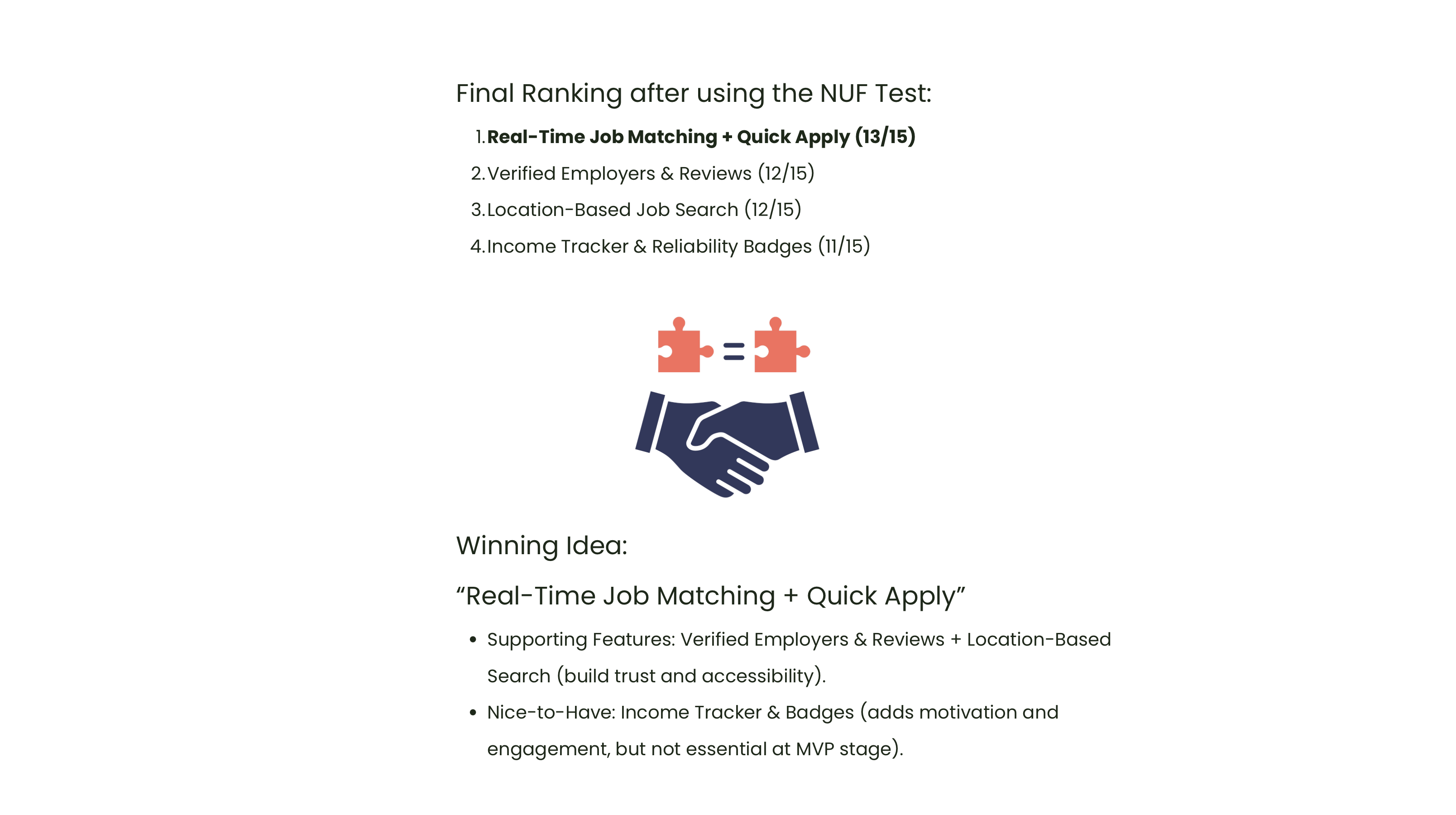
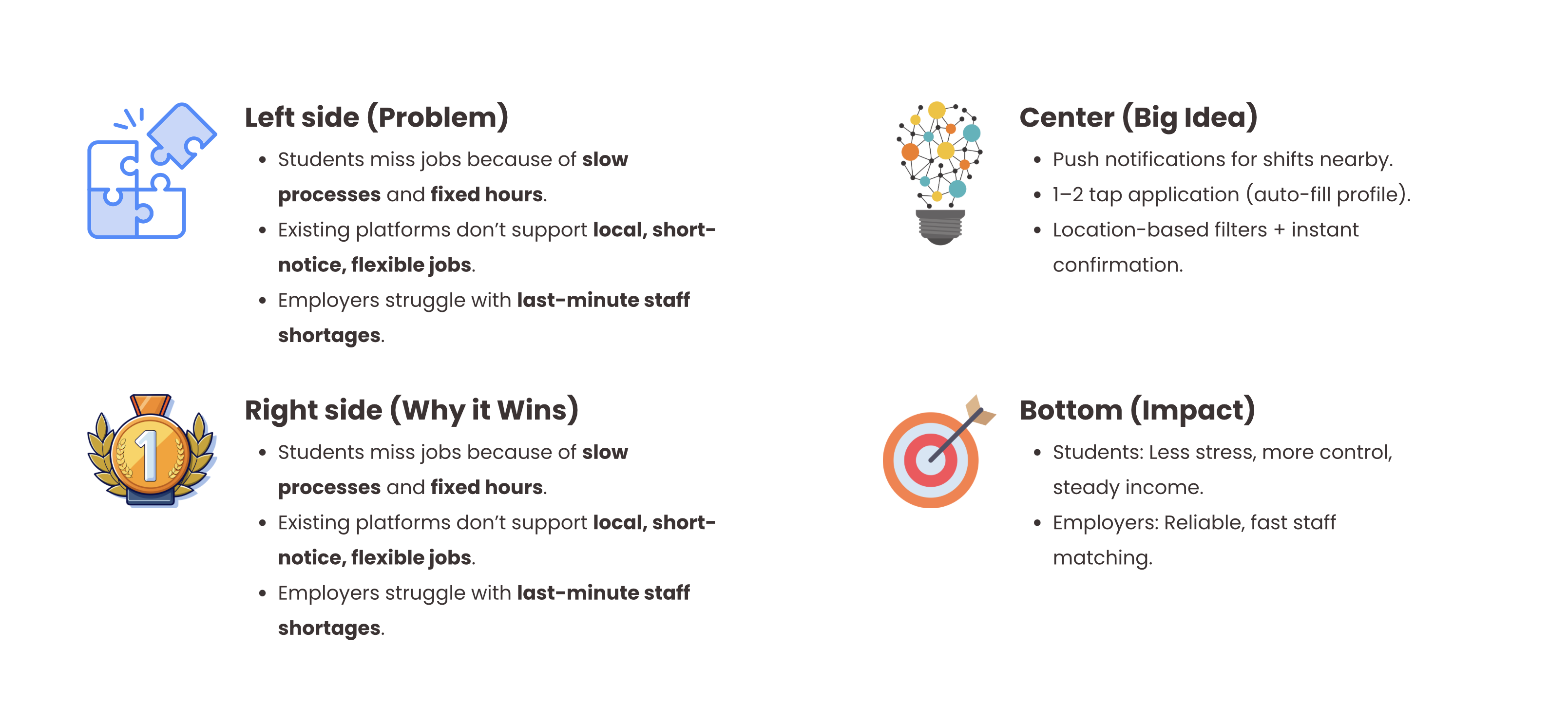
Refine the top idea
(Real-Time Job Matching + Quick Apply App)
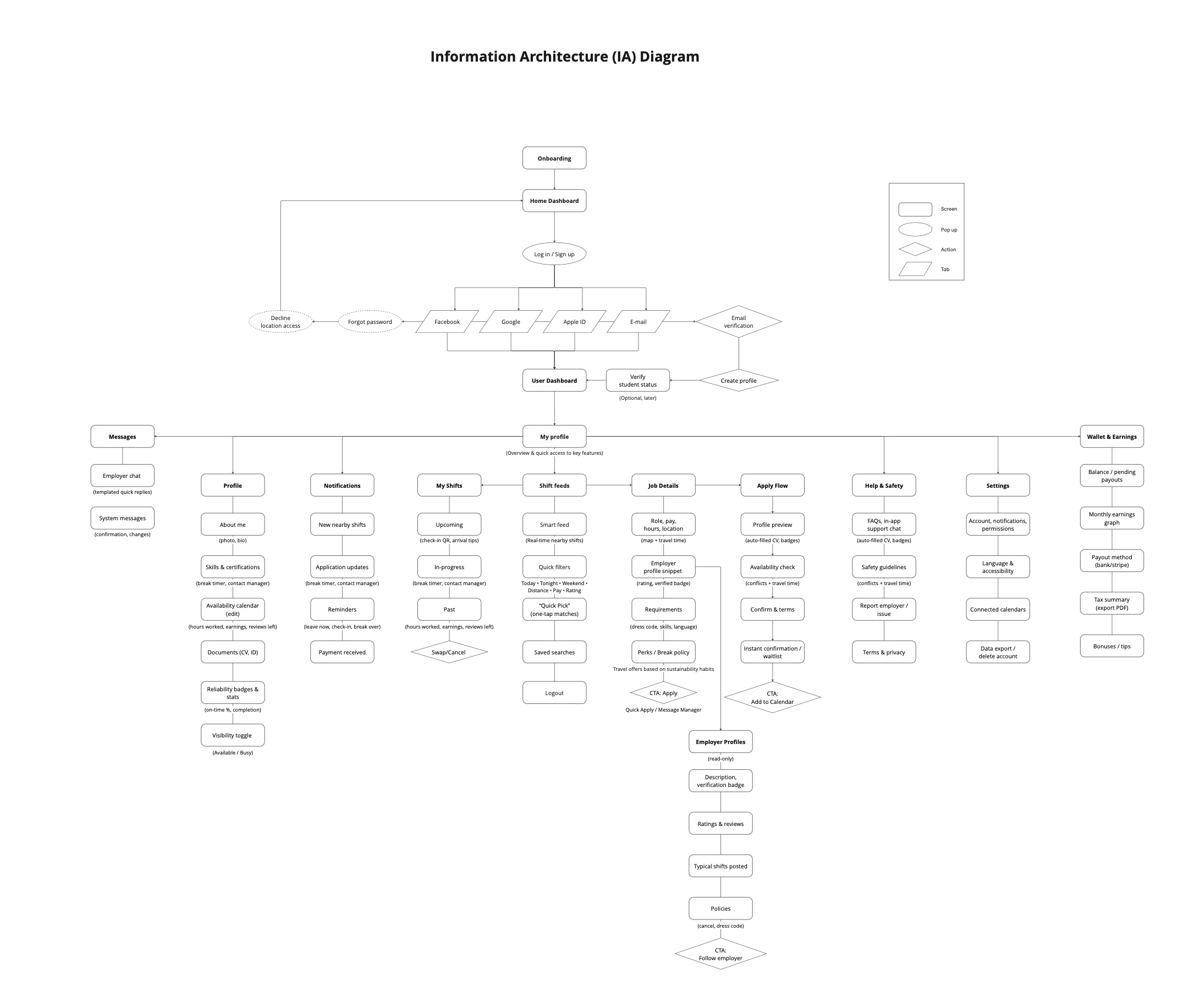
Wireframes
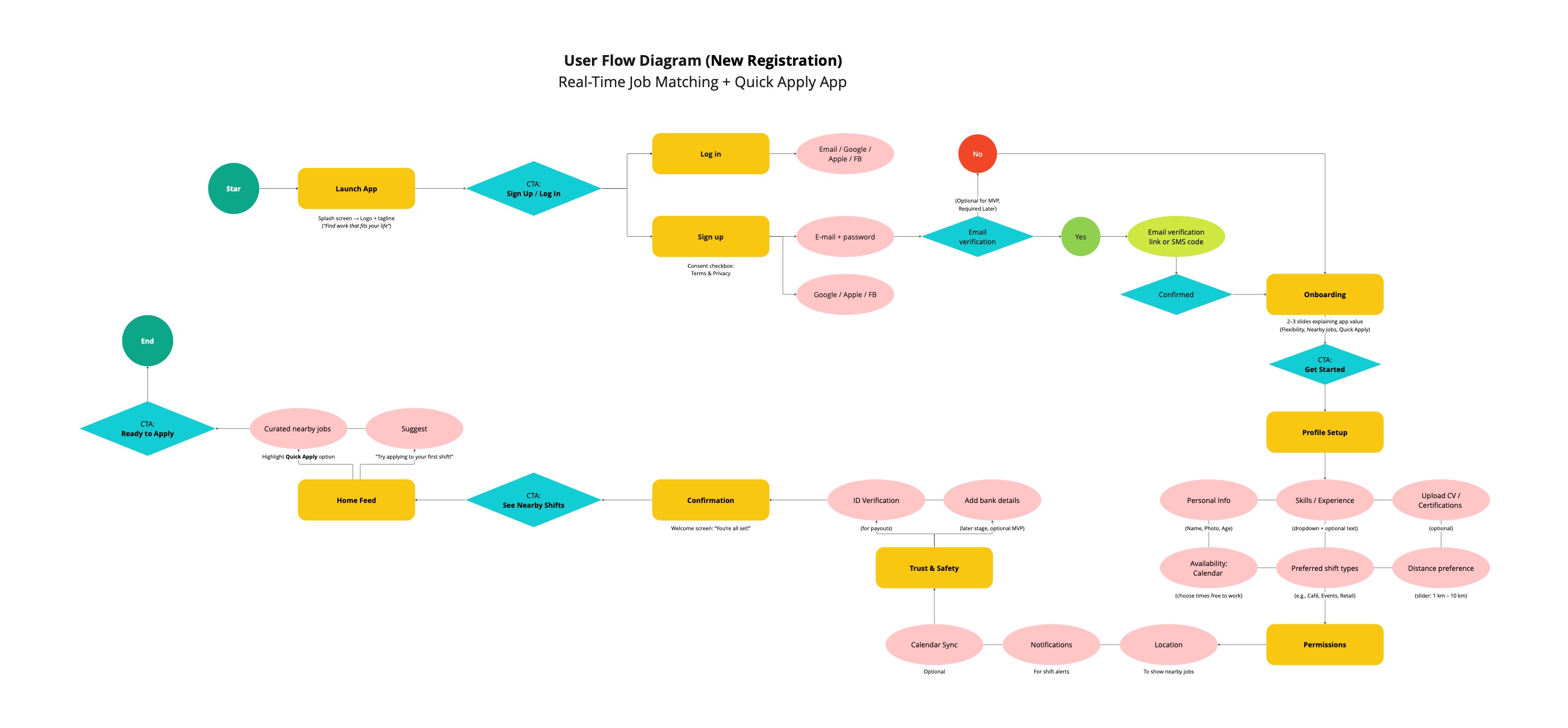
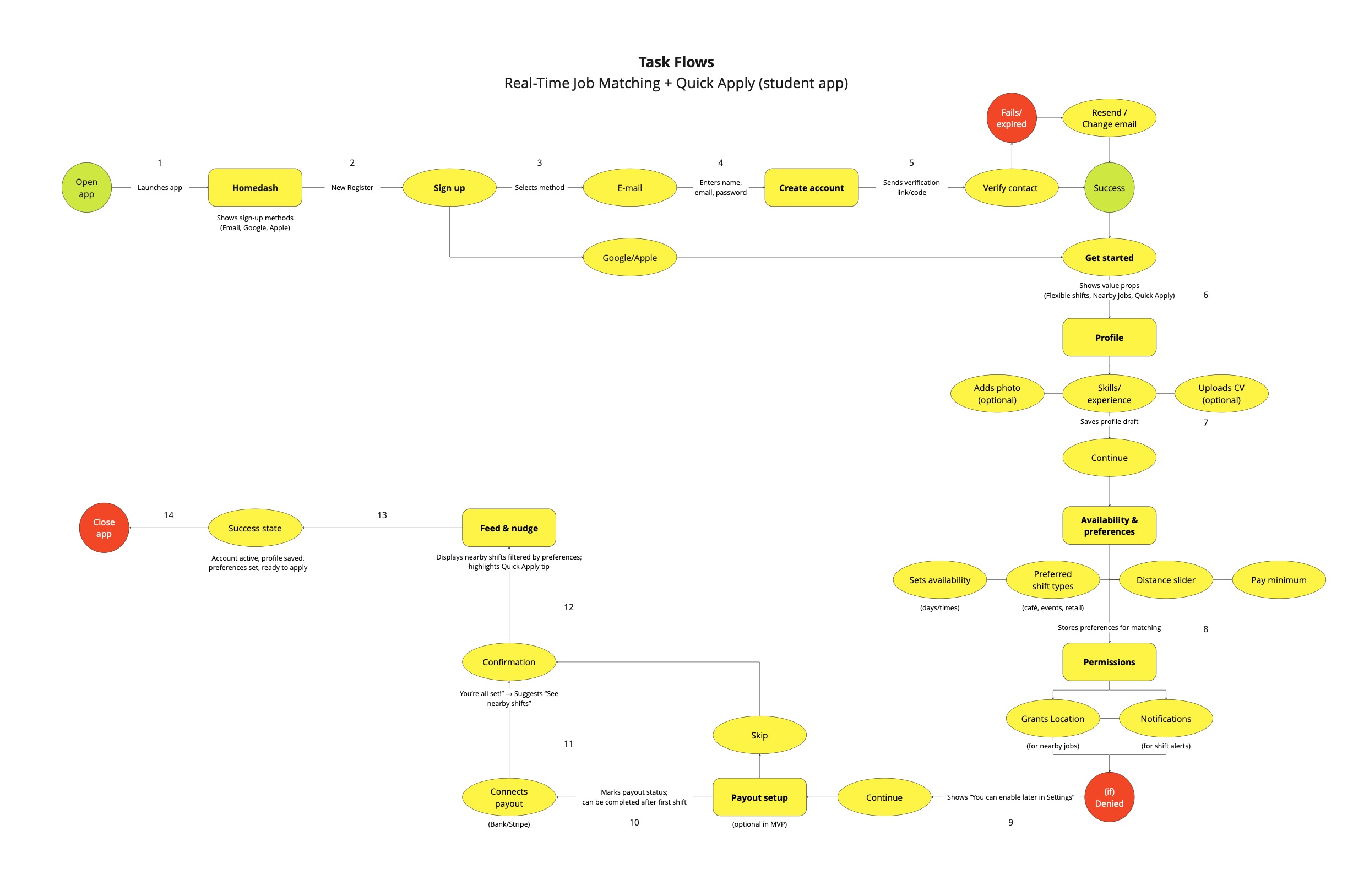
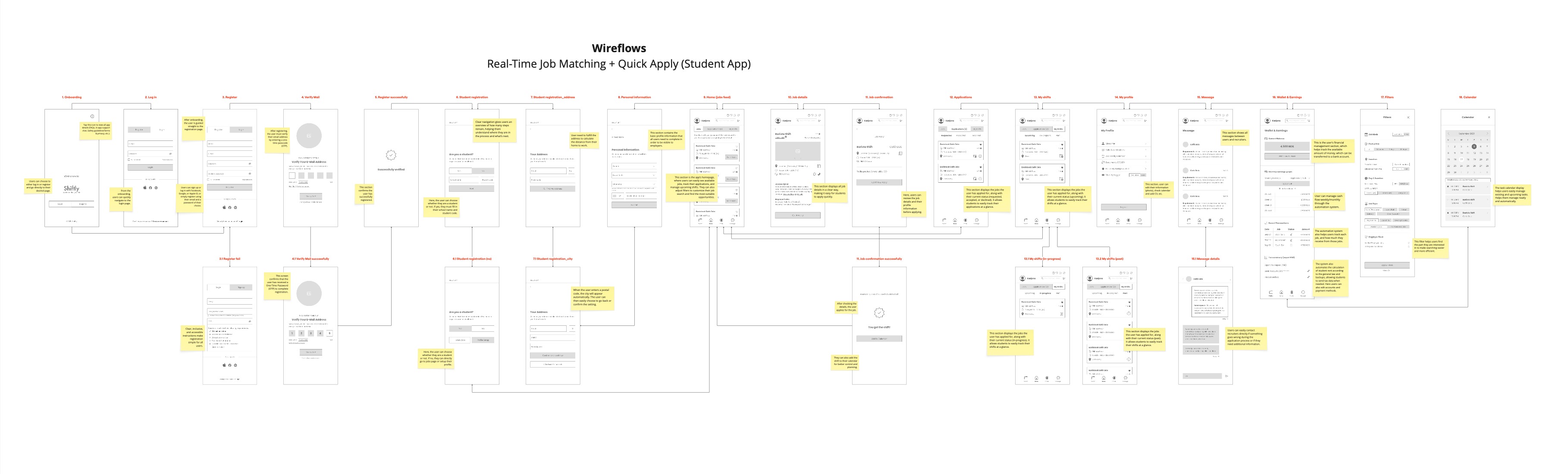
As part of the design process, I created wireframes to outline the structure and layout of the student job app without focusing on colors or visuals. Wireframes allowed me to quickly explore how students will navigate key features like the home feed, job details, and quick apply flow.
In addition, I developed wireflows, which combine wireframes with flow diagrams to show how users move through the app step by step. This makes it easier to visualize the user journey (e.g., registering, applying for a shift, confirming a booking) and ensures that all interactions feel simple and intuitive before moving into high-fidelity design.
Since the app’s name is too long, I decided to find a shorter and more industrial name. So the app’s new name will be Shiftly – it’s short, app-like, and directly connects to shifts & flexibility.
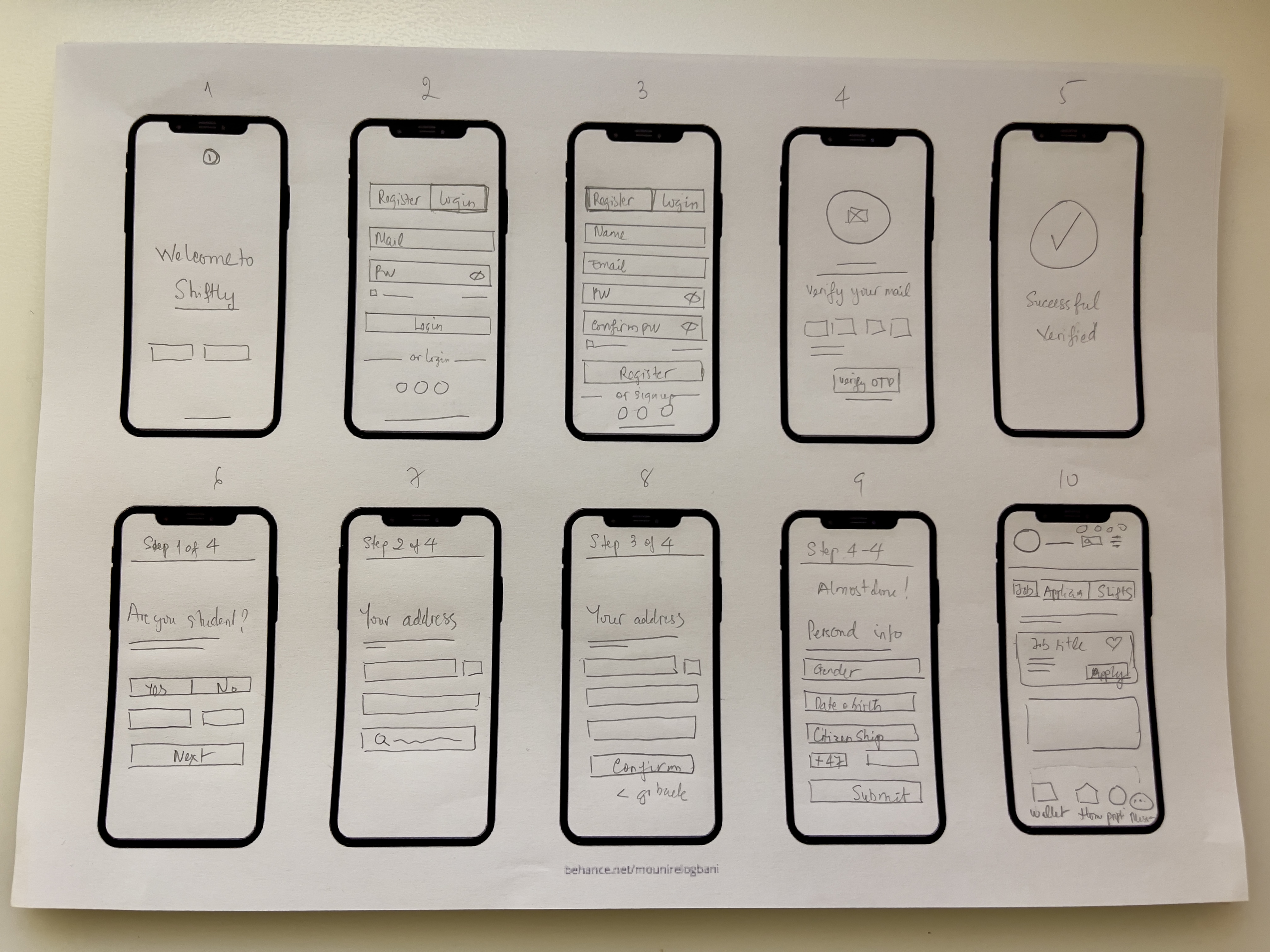
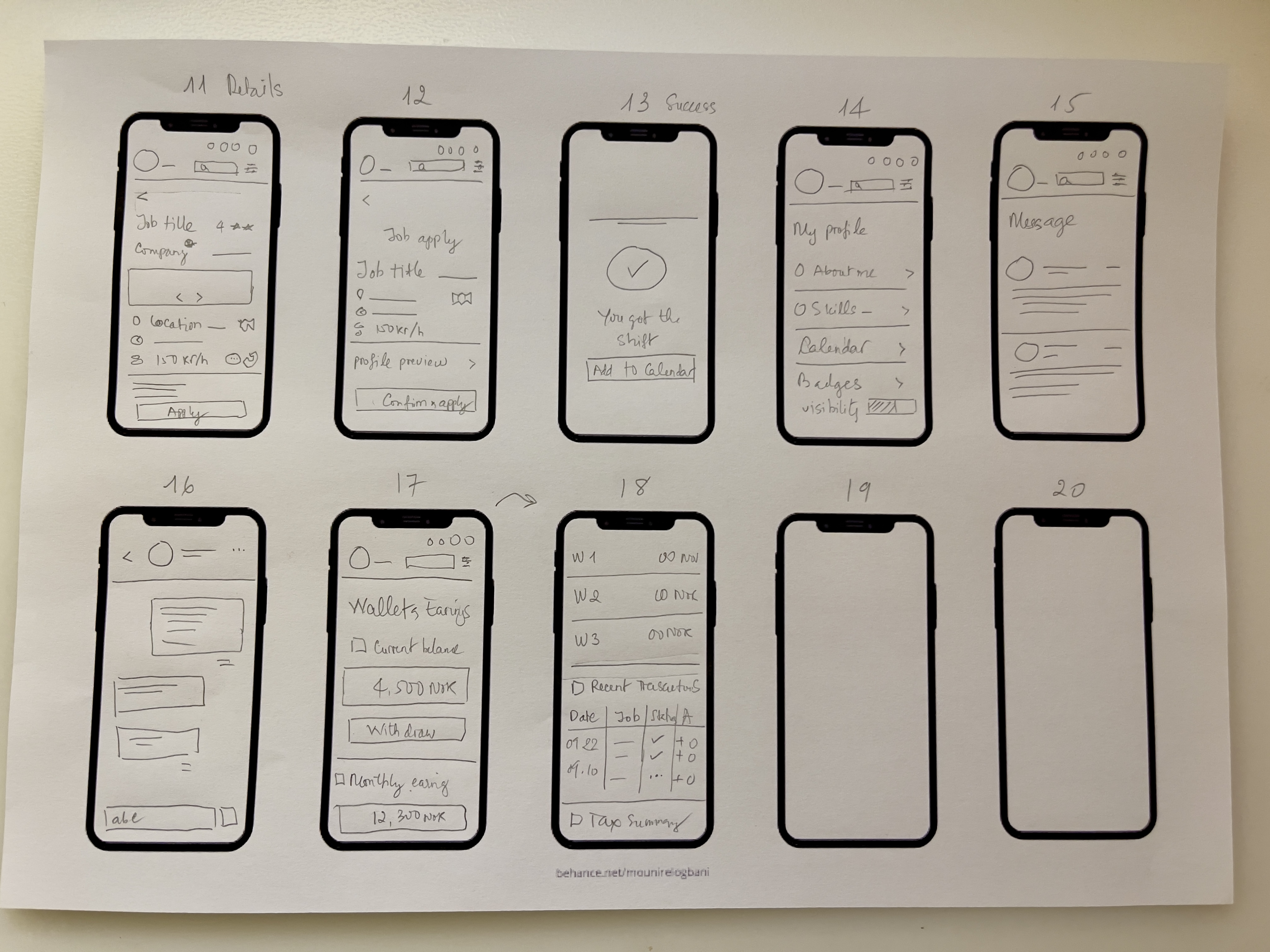
Low-fi Wireframes
Lo-fi Wireframes Link
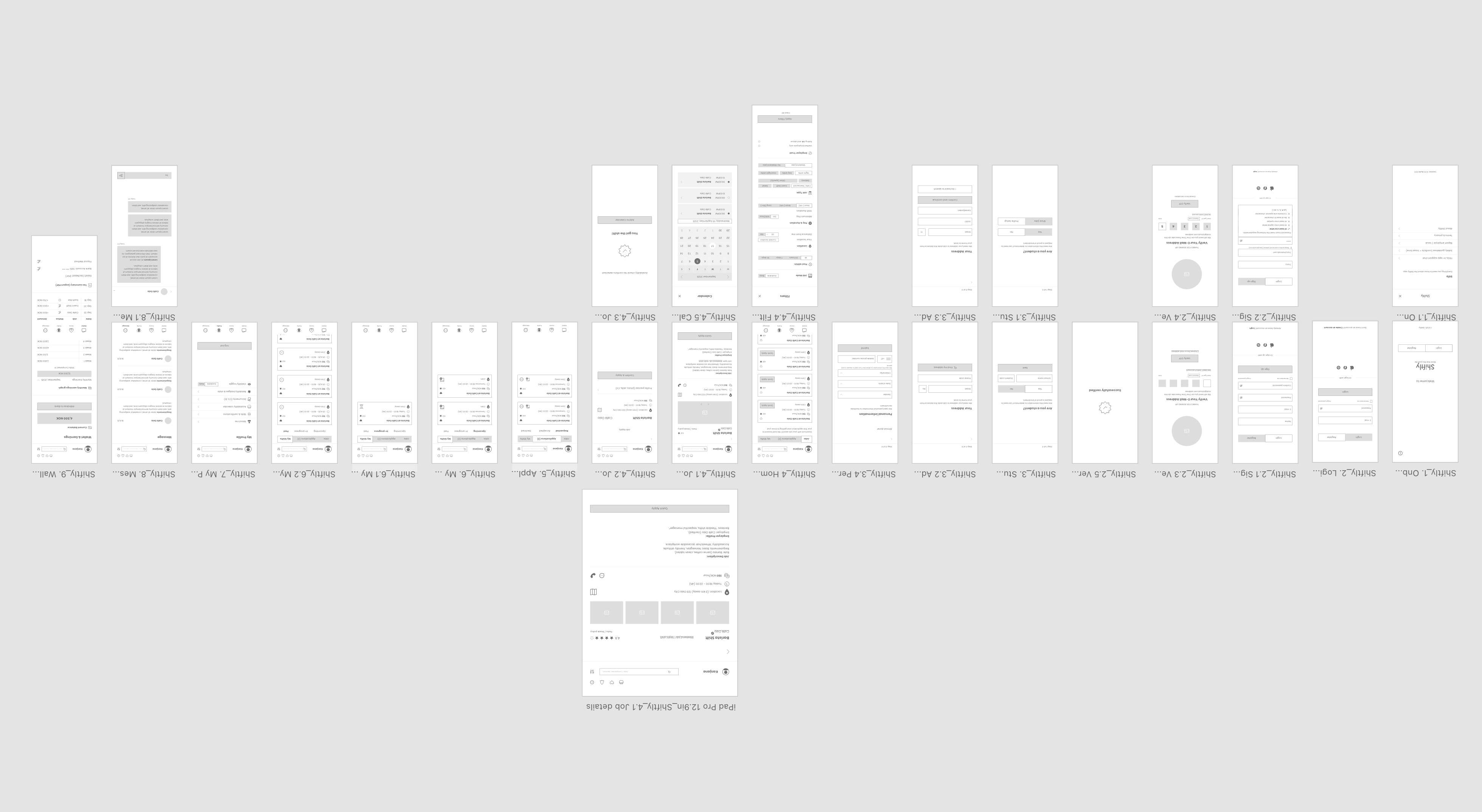
Hi-fi Wireframes
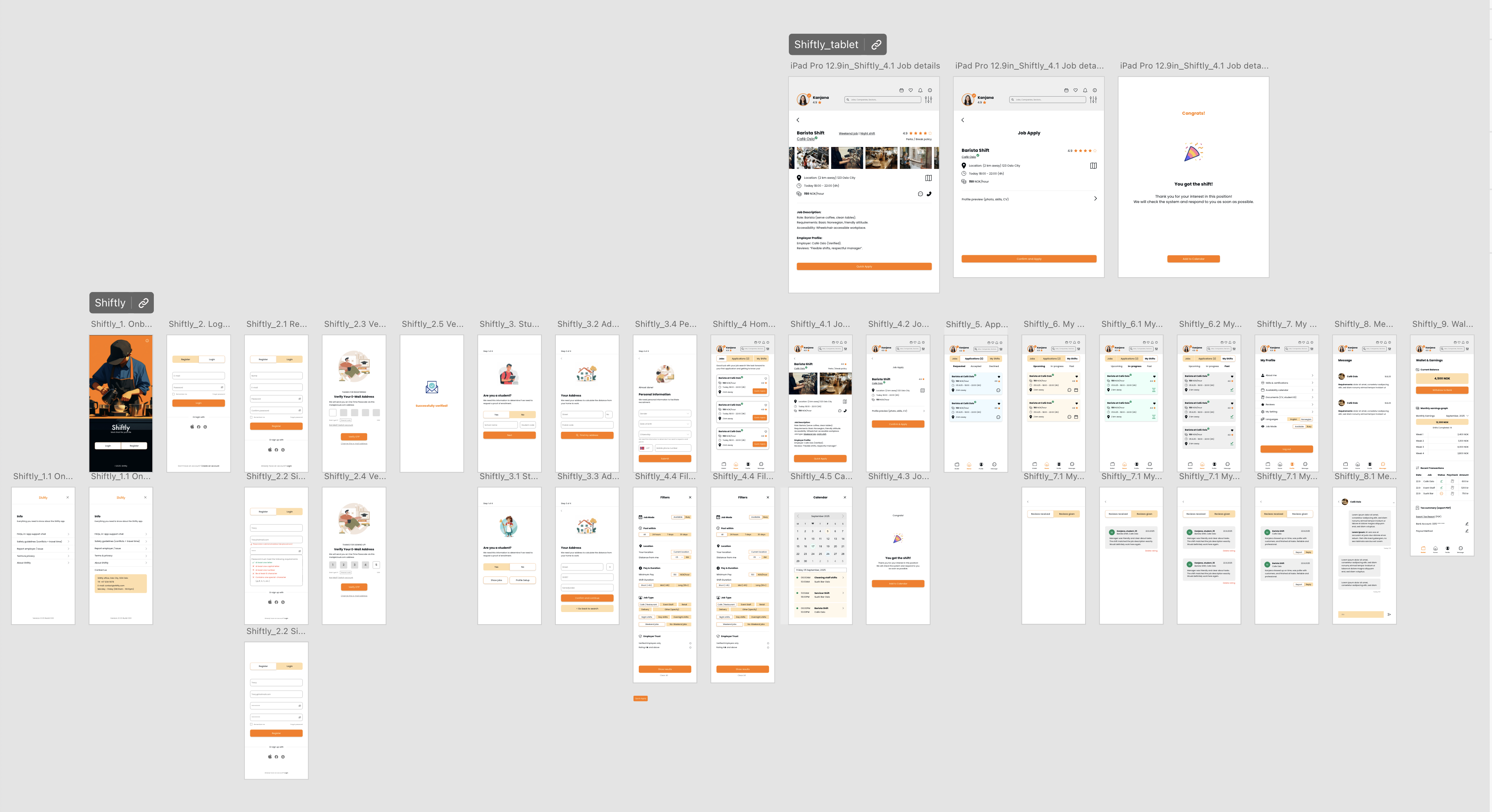
Responsive Design
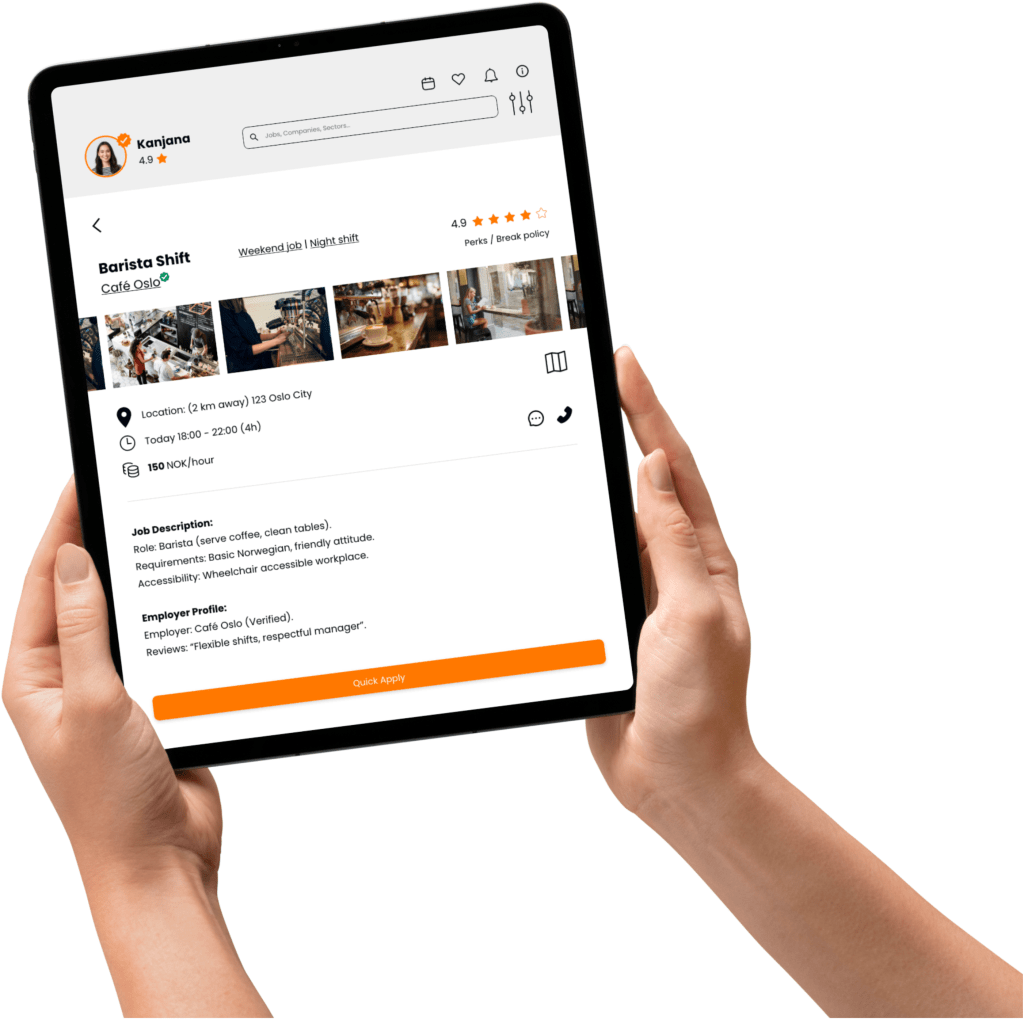
After completing the mobile version, I extended the design to tablet size to ensure a responsive layout.
Tablets give students more space to view details side by side (job info and employer info), reducing scrolling and improving readability while keeping the experience consistent across devices.
Wireframes link (tablet)
Wireflows
Shiftly Mini Design System
Brand Identity
- App Name: Shiftly
- Tagline: Work that fits your life
- Tone of Voice: Young, dynamic, friendly, supportive, clear, and trustworthy.
Color Palette (Accessible Contrast ≥ 4.5:1)
Primary orange (#FF7800)
Buttons, highlights (trust + action)
Secondary Green (#008E59)
Success states (booked shift, payment)
Neutral Beige (#FFDDAA)
Labels
Contrast black (#00070D)
Text
Error Red (#FF3A21)
Warnings, errors
Background Light (#FFFFFF, #EFEFEF)
App background
Typography
Headings (H1–H3): Poppins / Bold, 20–24px (WCAG minimum sizes).
- Body Text: Poppins / Regular, 16px (line height 1.5).
- Labels & Buttons: Poppins / Semi-bold, 16–18px.
Accessibility Guidelines (WCAG 2.1/2.2)
- Minimum contrast: 4.5:1.
- Text resizable up to 200% without breaking layout.
- Alternative text for icons & images.
- Large, consistent touch targets (≥44x44px).
- Simple language in job descriptions.
- Keyboard + screen reader support.
Collect & conduct User Testing
I conducted an in-person usability test of the Shiftly App (Real-Time Job Matching + Quick Apply) with two friends at their home. As a small thank-you, I treated them to sushi.
Before the session, I shared a short overview of the app and the testing process, along with a link to the mid- and high-fidelity wireframes. I also obtained their consent to record the screen for later reference.
The user tests delivered valuable insights and constructive feedback that will guide refinements and improve the overall user experience of the app.
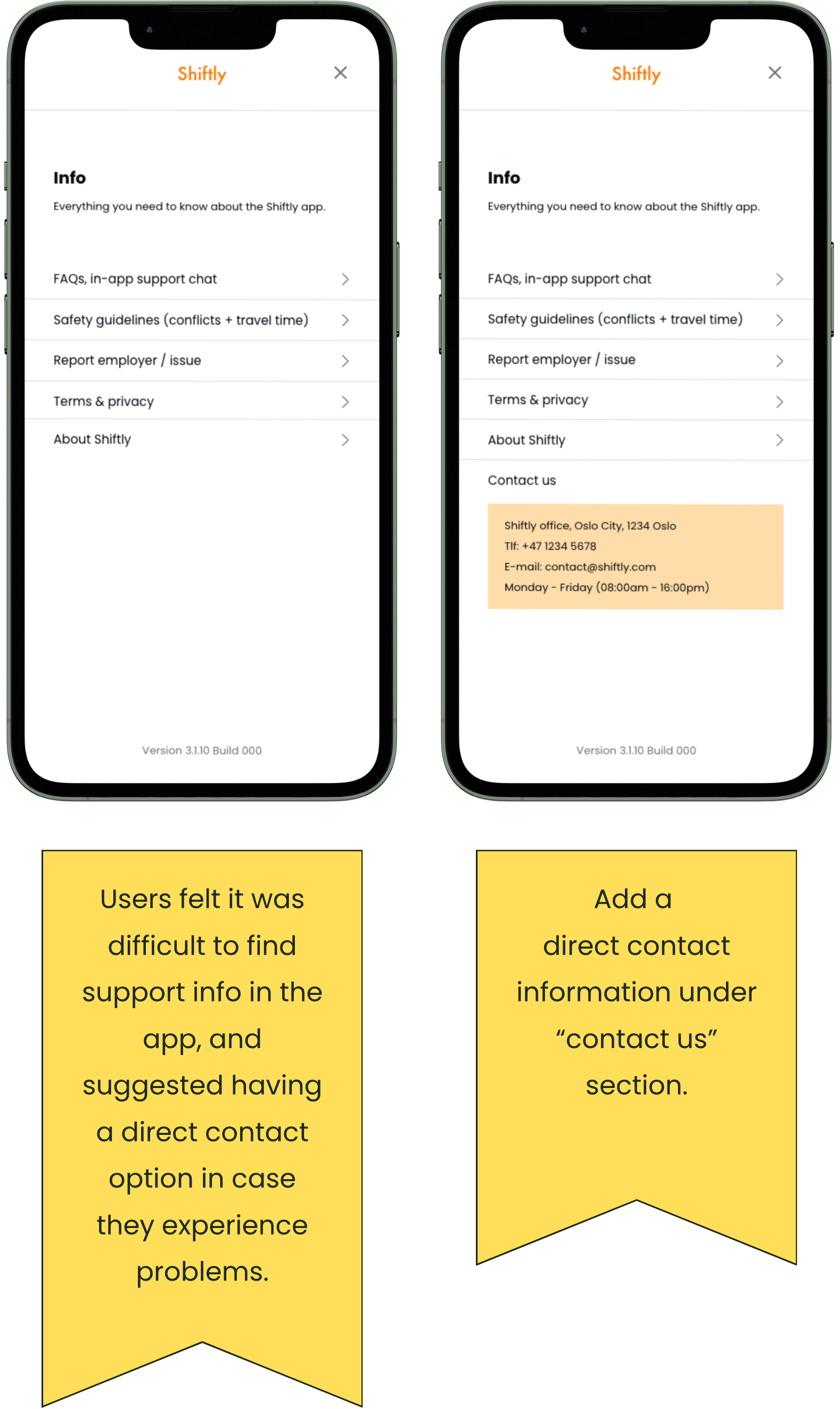
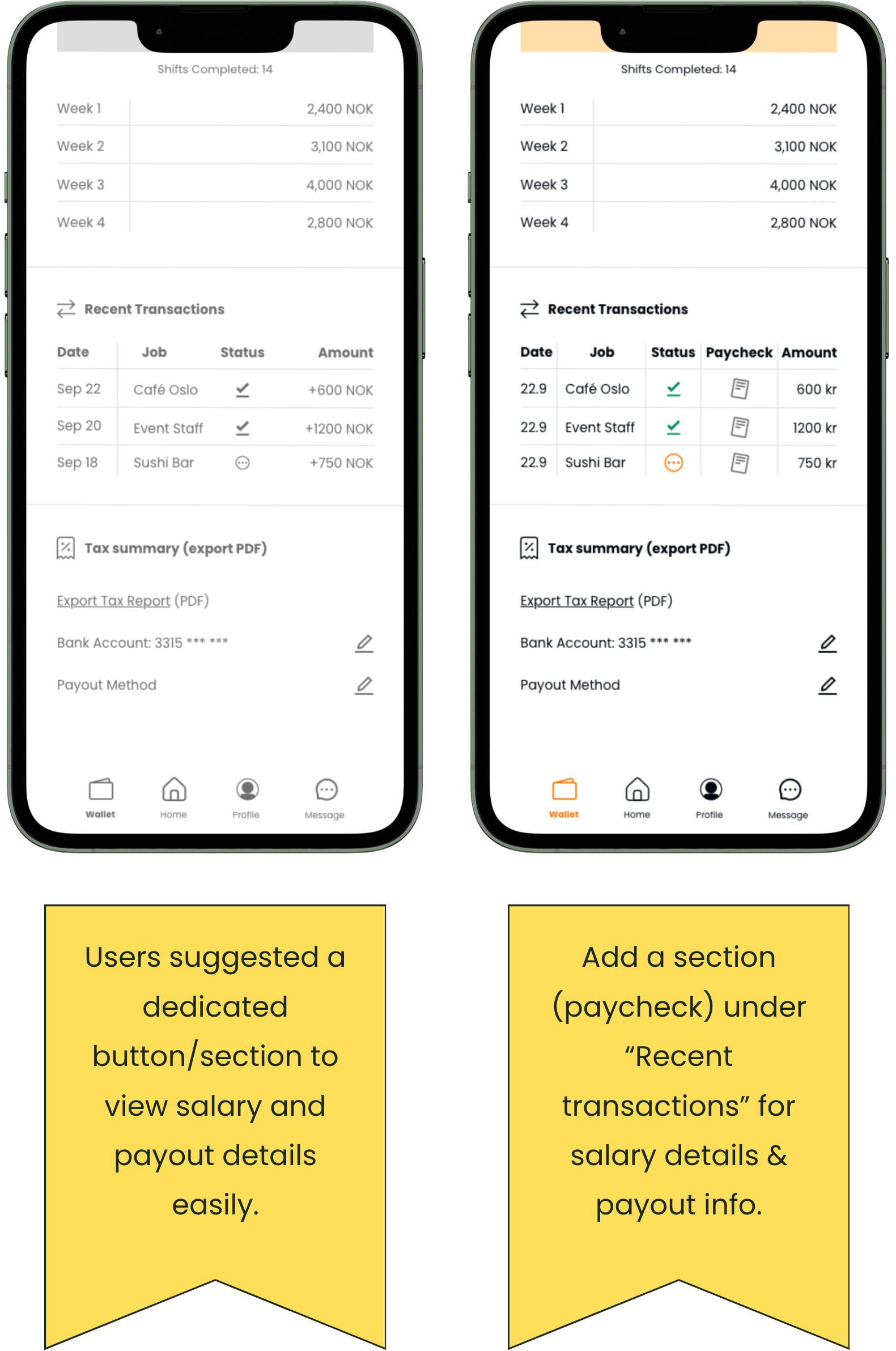
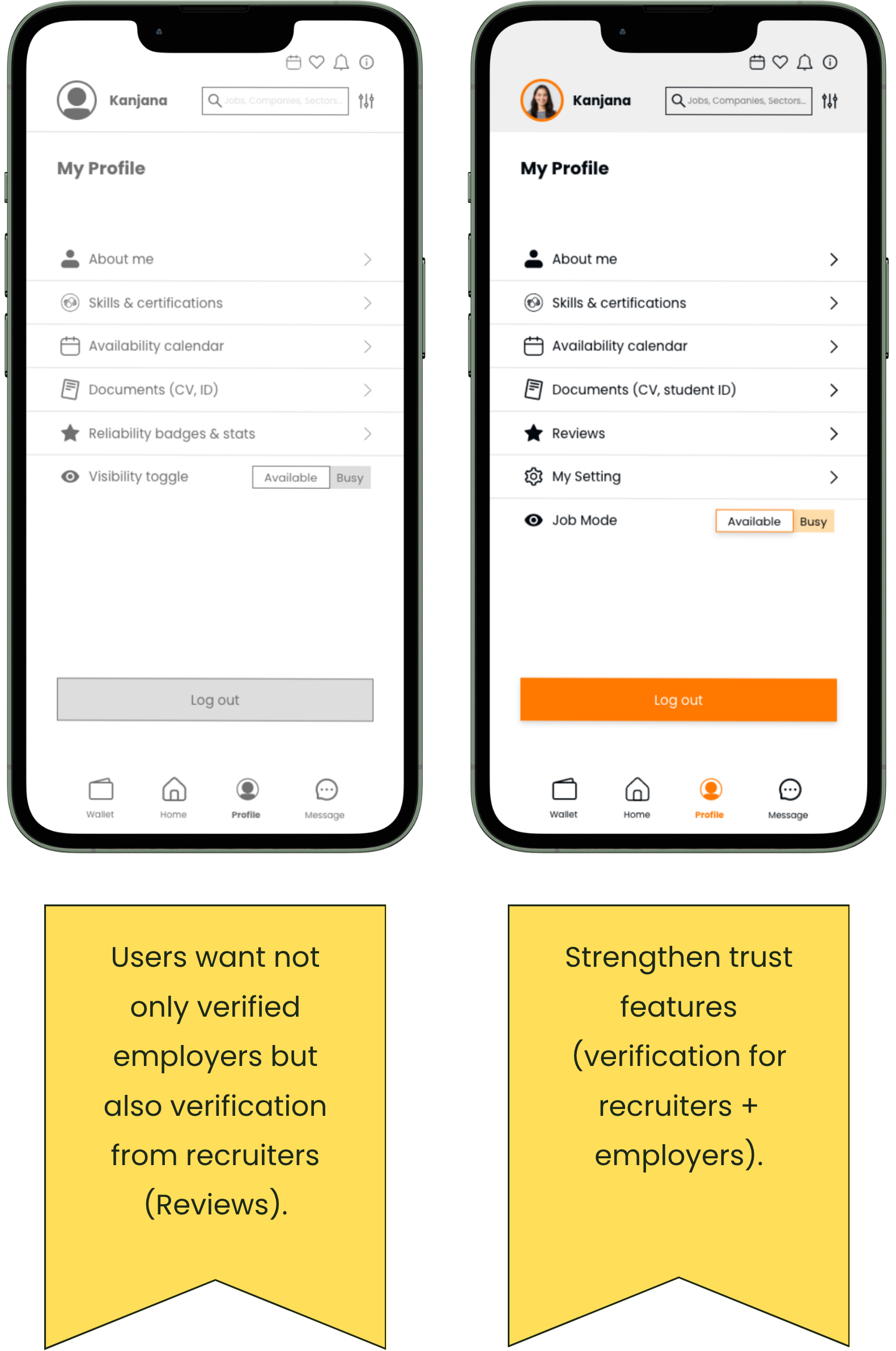
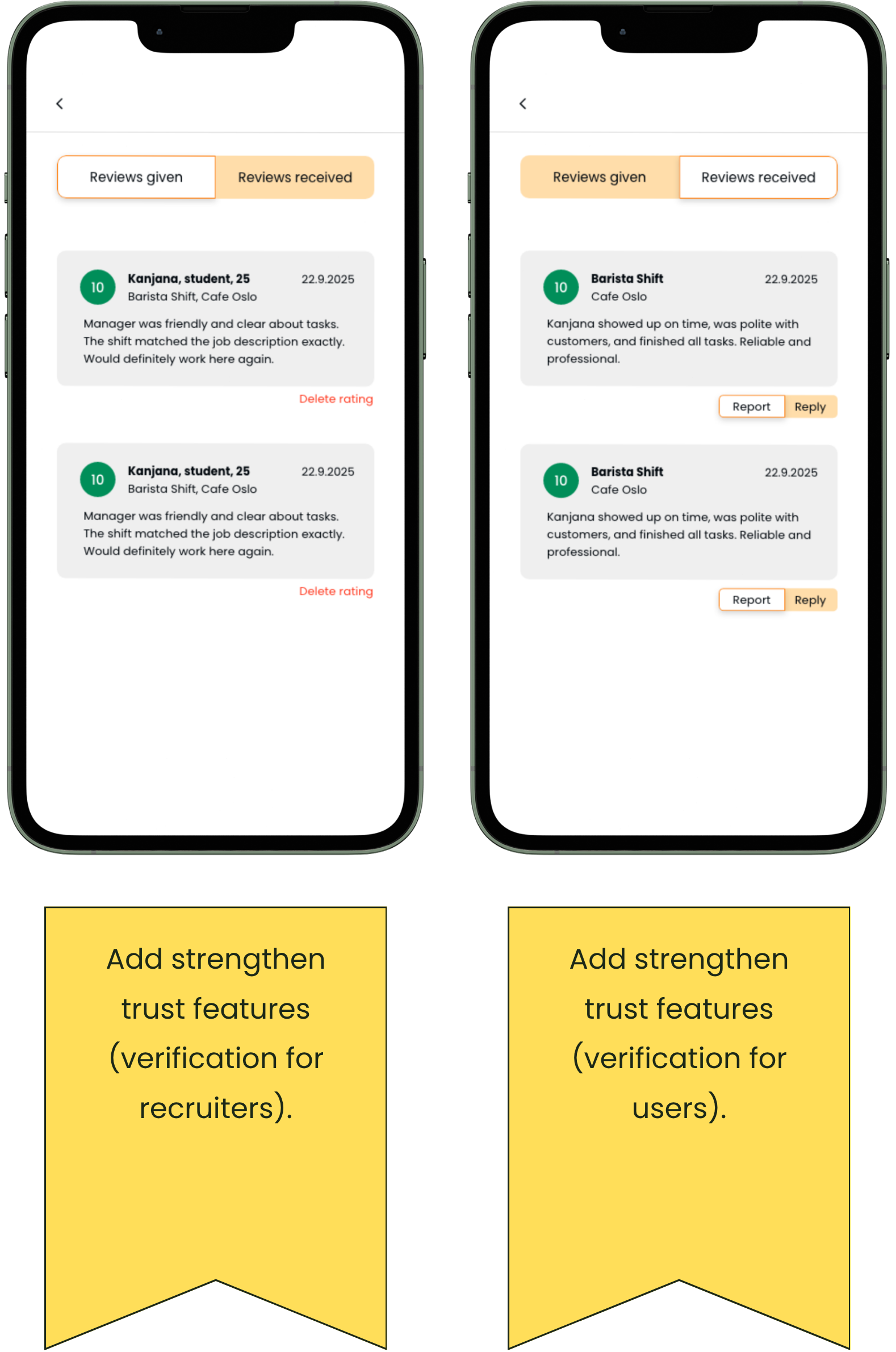
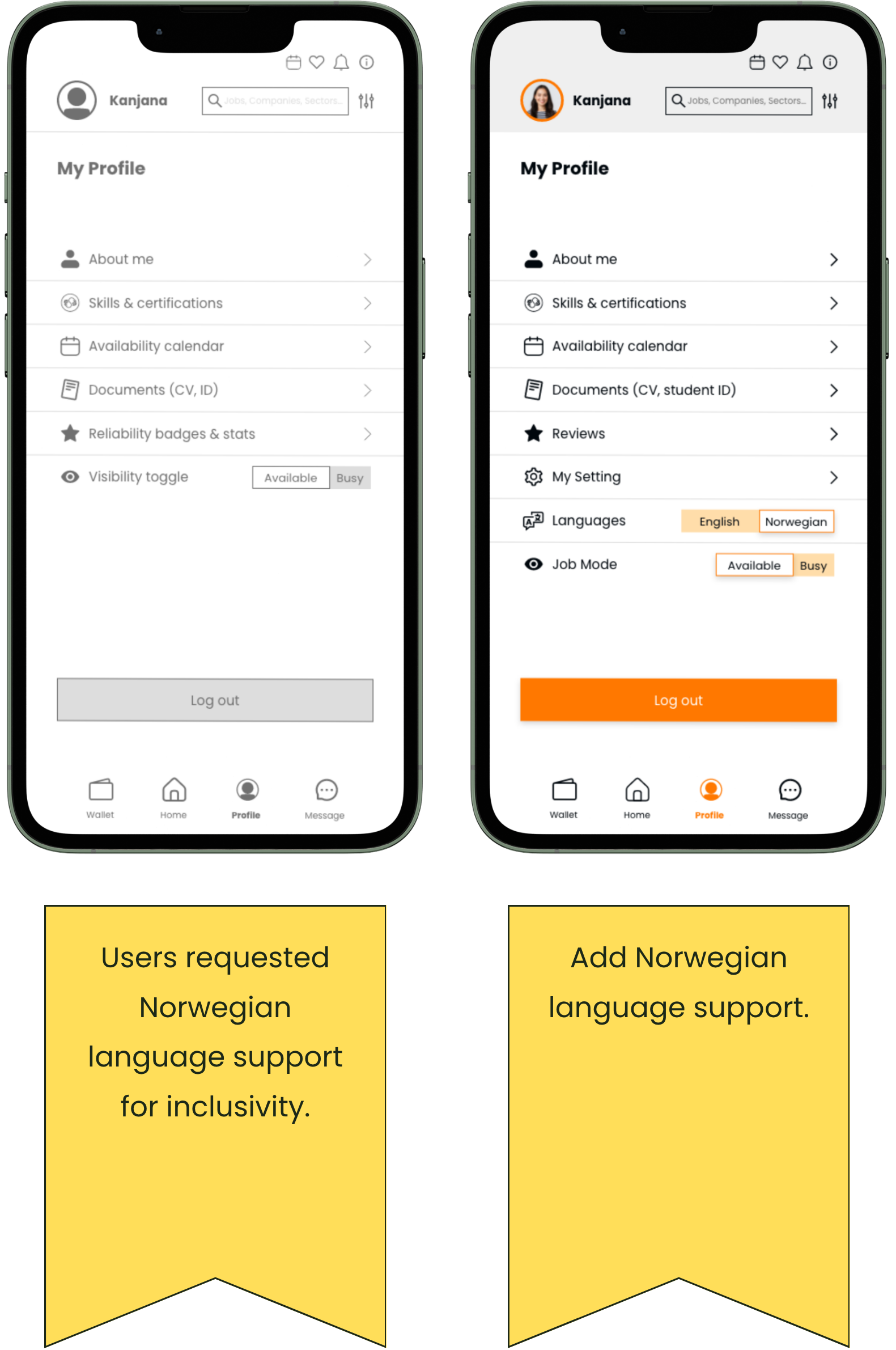
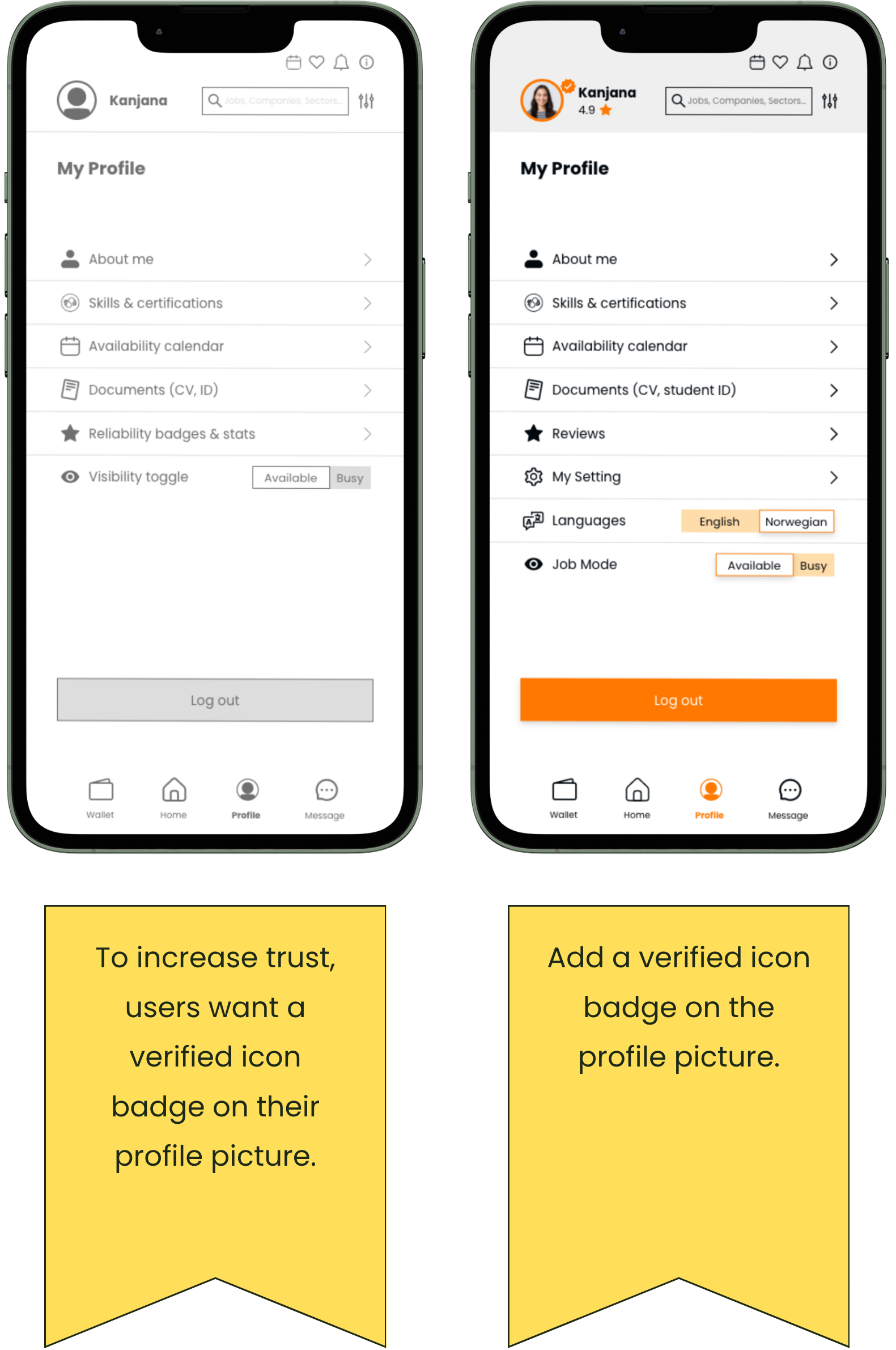
Report Findings – Shiftly
General Feedback
Easy to use
Users found the app intuitive and simple to navigate.
Job discovery works well
It was straightforward to browse and find relevant shifts.
Registration smooth
Signing up and setting availability was manageable.
Design praised
Clean and modern look.
Salary clarity
Suggested a dedicated button/section to view salary and payout details easily.
Language barrier
Users requested Norwegian language support for inclusivity.
Trust matters
Users want not only verified employers but also verification from recruiters before jobs are listed.

Conclusion
The Shiftly project explored how design can help students find flexible, local, and trustworthy part-time jobs. Through surveys, interviews, and usability testing, I discovered that students struggle most with unpredictable schedules, lack of transparency, and slow application processes.
By applying the Design Thinking process, I developed wireframes, wireflows, and a design system that focus on Quick Apply, verified employers, and accessible, responsive design. User testing confirmed the app’s strengths—simplicity, ease of use, and modern design—while also highlighting areas for improvement such as Norwegian language support, clearer salary details, and stronger trust features.
In conclusion, Shiftly demonstrates the potential of a student-centered job platform that is fast, inclusive, and reliable. The project not only sharpened my UX design skills but also deepened my understanding of how research, accessibility, and iteration shape effective digital solutions.
 AMA DEZIGN